Polymer-modified sprayed concrete from Wacker Chemie AG
Whether in tunneling, mining, hydraulic engineering or road construction, the application of sprayed concrete entails rebound – a significant time and cost factor. For this reason, Wacker Chemie AG developed a new line of polymeric binders for concrete applications that considerably reduce spray rebound – and at the same time optimize the concrete’s properties.
An important quality factor in the performance of sprayed concrete is rebound. Rebound alters its properties, and the excess material cannot be reused but must be disposed of as waste. Reducing rebound is therefore important for both technological and economic reasons.
The newly developed product line Etonis® stands out by a major enhancement in rebound properties. Moreover, polymer-modified sprayed concrete has some interesting concrete properties and provides yet another means for product differentiation. Beside outstanding processability without the risk of separation, it offers good compaction characteristics and high compressive strength. The polymer-modified sprayed concrete adheres excellently even to difficult substrates such as damp tunnel walls and has an improved CO2 resistance. These new polymer binders can be shipped in either liquid or powder form.
Application in Tunneling
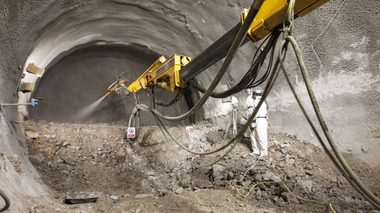
Especially in tunneling, time and the consumption of material are critical. The solution lies in adding polymeric binders: Modifying sprayed concrete with polymers saves time and materials effectively. Polymer-modified sprayed concrete is suitable for both wet and dry spraying. Both methods benefit from polymer modification and have many advantages to offer (Table 1).
Development Tests
The first development tests were designed to determine the proportion of additive that reduces sprayed concrete rebound, yet still provides the desired concrete properties. Various wet spray concrete formulations were applied to standardized test areas to study their effects on the sprayed concrete’s properties. Design of experiments (DoE) was carried out to determine the parameters needed for planning the next level of tests. 2 to 3 m3 of concrete were laid for each trial. To ensure a homogeneous mixture, only midstream concrete was used.
In the course of the investigations it became apparent that inclusion of the additive significantly reduced rebound, regardless of the formulation. Both modified concrete formulations show that, with increasing amounts of additive, rebound first declines, reaching a minimum, after which further additive increases rebound again (Fig. 1).
Concrete loses aggregate through rebound, which causes the cement concentration in the applied sprayed concrete to rise. In general, as the cement concentration rises, the strength of the concrete increases as well. As a rule, rising rebound equates to increased ultimate strength. Fig. 2 shows the strength profiles of polymer-modified concretes compared to a reference concrete. The reference mixture showed a linear progression of early strength over the entire measuring period.
It can be clearly seen that the mixtures containing the highest proportion of liquid or powder additives and pure superplasticizer displayed the least rebound and, as expected, the lowest strength. The development tests showed that the mixture with 5 % solid additive had the most favorable strength progression, as it could be processed longer, and exhibited a similar or even better initial slump than the reference mixture. Furthermore, the rebound values of this mixture showed that the objective of halving rebound had been met. Most convenient to process were the concrete formulations modified with liquid additive.
Polymer-Modified Sprayed concrete at the Stetten Salt Mine
Some aspects of these tests, for instance the recipe for wet-mix sprayed concrete, can be determined in the laboratory. However, the complex way that metering, mixing, conveying and nozzle systems interact with the application technology can only be determined by large-scale testing.
An opportunity was given when a new access gallery was built in a salt mine in Stetten (southwestern Germany). This mine, owned by Wacker Chemie AG, has been producing rock salt for over 150 years. In 2007, construction of a new, 905 m access route with a 10 % incline that would allow standard trucks to pass through the tunnel was begun.
The construction of the new tunnel was an ideal occasion to investigate the polymer-modified sprayed concrete’s properties under practical conditions – including any improvements. To prepare for the on-site use of this sprayed concrete technology, basic lab tests were carried out. Afterwards, the new, polymer-modified sprayed concrete was tested under realistic application conditions. In addition to the decrease in rebound, these trials showed that the mixtures exhibited improved adhesion and impermeability.
After tunneling ran smoothly in the Stetten salt mine for the first few months, groundwater began to seep in after about the first 450 m of tunnel. The original, wet-mix formulation of the sprayed concrete satisfied under dry conditions, but showed weaknesses in adhesion when applied onto a damp substrate. As the prior lab tests had shown improved adhesion and impermeability, it was decided to use the improved polymer-modified sprayed concrete at this point.
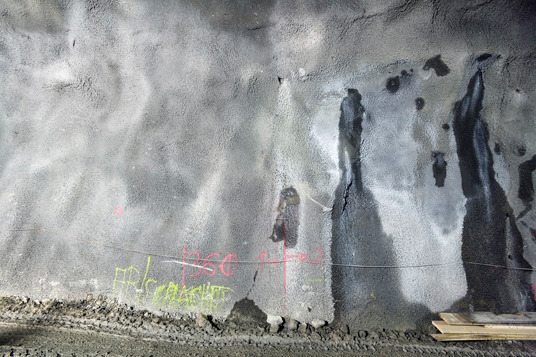
For this large-scale application, the aqueous polymer was used for the concrete mixture. A total of 15 m3 of additive was metered into the concrete to give a final concentration of 40 l additive per m3 of concrete. On inspection of the test surfaces in the side wall, the standard sprayed concrete (Fig. 3, right) was found to exhibit a large number of wet patches, whereas the polymer-modified spray-ed concrete (Fig. 3, left) demonstrates much better adhesion to the wet substrate, exhibits higher impermeability, and is less likely to form cracks.
The use of modified sprayed concrete under construction site conditions proved its worth at the access gallery. Switching to polymer-modified sprayed concrete allowed the new entrance to be completed in time.
Conclusion and Outlook Polymer-modified concrete possesses valuable potential, both technical and commercial. During the development work, fundamental considerations were made about polymer-modified sprayed concrete’s economic feasibility based upon experimental results. Reduced rebound through use of the new additive has a decisive influence here. This means that the additional costs of modifying the sprayed concrete are offset by the time and material saved, and converted into significant profits (Table 2).
The new polymer-modified sprayed concrete is easy to handle and versatile: It can be applied vertically and on ceilings, is suitable for tunneling and mining, as well as for use on slopes and in canals or conduits. In all these applications, the new sprayed concrete reduces overall system costs and at the same time optimizes the concrete’s properties.
K. Bonin, Dr. J. Bezler; Wacker Chemie AG


Area of side wall with local application of...