Frankfurt U5 Urban Railway Extension: Construction of Tunnels and Underground Station
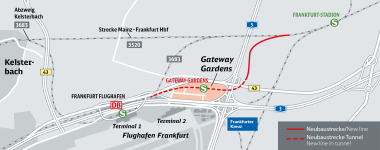
The expansion of urban infrastructure poses a considerable challenge, particularly in densely populated areas. The extension of the U5 urban rail line will provide Frankfurt’s Europaviertel with a state-of-the-art, high-capacity connection to the city’s underground network. This project is not only a milestone for mobility and urban development in Frankfurt, but also a prime example of the implementation of technically demanding tunnelling projects under extreme inner-city conditions. On behalf of SBEV – Stadtbahn Entwicklung und Verkehrsinfrastrukturprojekte Frankfurt GmbH, Porr‘s joint venture – comprising the engineering, tunnelling and specialist civil engineering divisions – is constructing an approximately 1160 m-long underground section, including the new Güterplatz underground station and the connection to the existing metro tunnel at Platz der Republik.
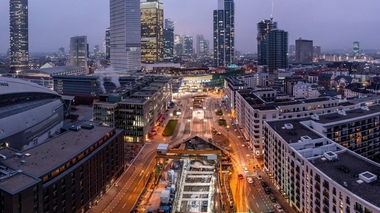
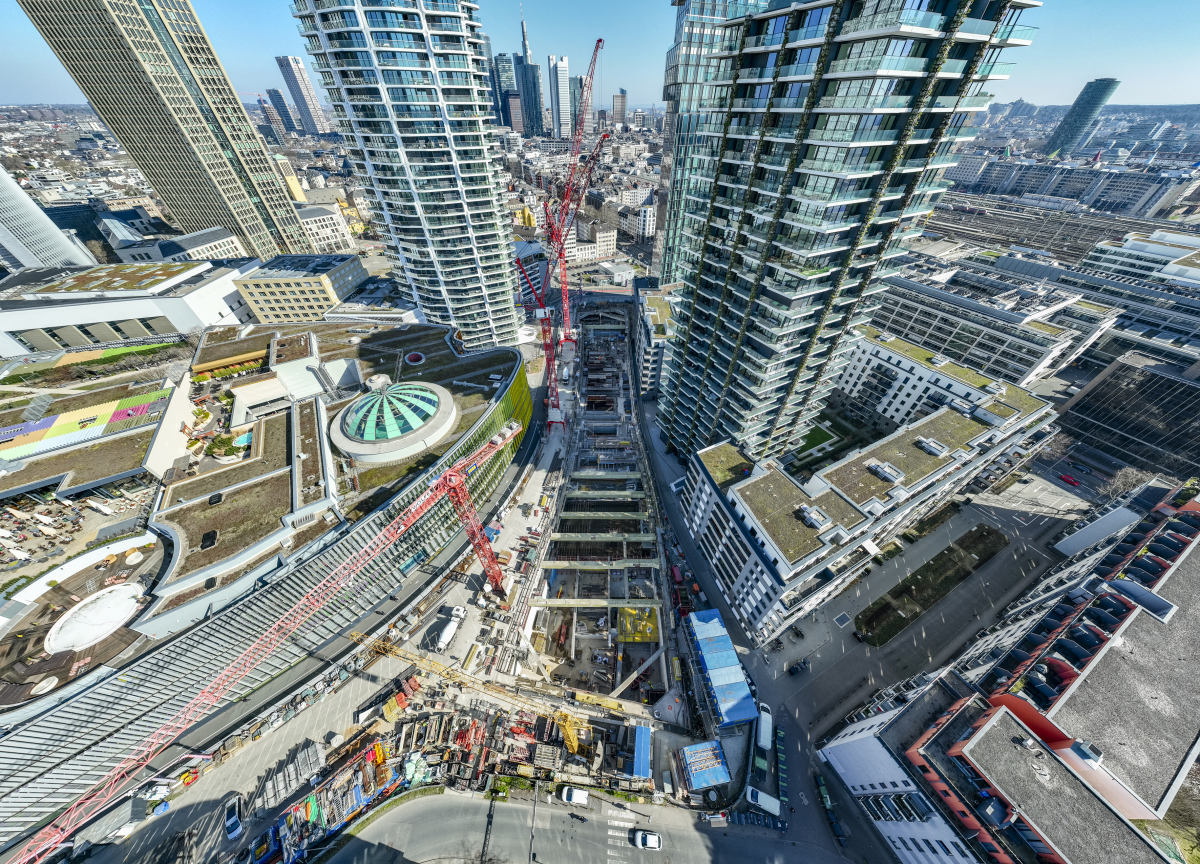 Extension of Frankfurt’s U5 urban railway line to the Europaviertel: On behalf of SBEV, Porr, as part of a joint venture, builds an approximately 1160 m-long underground section, including the new Güterplatz underground station and the connection to the existing underground tunnel at the square “Platz der Republik”
Credit/Quelle: PORR
The Europaviertel is one of Frankfurt’s largest inner-city development areas. Once completed, around 30 000 people will live and work here. The extension of the U5 urban rail line by around 2.7 km, with four new stops, is a key prerequisite for the neighbourhood’s transport links. The project is set within an urban environment characterised by high building density and existing transport infrastructure. The urban planning requirements are correspondingly complex: in addition to integration into the public transport network, aspects such as noise protection, traffic management during the construction phase and the minimisation of disruption to the urban environment must be taken into account.
Ground Conditions, Groundwater and Inner-City Location
The predominantly underground route of the U5 runs through a highly sensitive urban environment characterised by dense development, existing transport infrastructure and a high groundwater level. The geological conditions are characterised by Frankfurt clay interspersed with limestone banks, which significantly influences the selection and wear of the drilling tools. The complex ground conditions, as well as the immediate proximity to existing structures, require the Porr team to employ construction methods that minimise settlement, maintain above-ground traffic and reduce disruption to the urban environment to a minimum.
TBM and Conventional Tunnelling
 Construction of the tunnel inner lining against the existing wall of the tunnel beneath the square “Platz der Republik”
Credit/Quelle: PORR
A milestone in the project is the first-ever use of a tunnel boring machine (TBM) in Frankfurt am Main. “EVA” (Europaviertel anbinden/Connecting the Europaviertel), a TBM specially designed for the project, was deployed. Weighing around 580 t, the TBM completed a total of approximately 1700 m of tunnel in two bores from September 2019 onwards, during which 8358 segments were installed to form the permanent lining. Mechanised tunnelling ended in each case just before the existing wall of the existing underground tunnel beneath Platz der Republik.
The planning and execution of the mechanised tunnel boring took place whilst taking numerous technical and logistical aspects into account. These included coordinating the delivery of tunnel segments, disposing of the excavated material, and protecting the work areas from the effects of urban traffic and groundwater.
Due to the complex boundary conditions, the final metres to the existing structure could not be excavated using a TBM. Here, the tunnelling was carried out using conventional methods with compressed air. Mechanised tunnelling was finished in May 2021; conventional tunnelling was safely completed by the end of March 2022. The transition between TBM tunnelling and conventional tunnelling required the dismantling of the tunnel boring machine, including the cutting wheel weighing around 72 t, as well as extensive preparations for working under pressurised conditions.
Ground Freezing
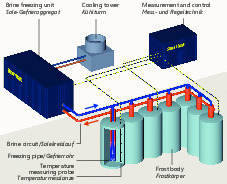
Ground freezing played a key role in constructing the connection to the existing tunnel. This method enables safe and waterproof construction progress under difficult groundwater conditions and minimises the risk of water ingress and settlement. A calcium chloride brine with temperatures down to approximately -37 °C was used as the refrigerant. This method proved to be cost-effective for the extended period of use, whereas the alternative use of liquid nitrogen would only have been suitable for short-term specialised applications. The freezing time required to reach the necessary temperatures and ice core diameters was around 50 days. Two redundant refrigeration circuits and an emergency power supply ensured that the freezing conditions remained stable at all times.
Special Civil Engineering Works Carried Out in Parallel With Tunnel Excavation
Extensive special civil engineering works were carried out in parallel with the tunnel construction works. On East Boulevard, excavation pits were created for the start and end sections of the tunnel tunnels and for the tunnel constructed using the cut-and-cover method. To this end, 18 wells with diameters of Ø 880 mm were constructed for groundwater lowering and monitoring. In addition, 92 dewatering lances with diameters of Ø 152 mm were installed.
The work was carried out in Frankfurt clay containing interbedded limestone banks, which led to increased wear on drilling tools. At the same time, site logistics and the deployment of equipment had to be precisely coordinated, as the work took place whilst tunneling operations were ongoing and within a confined inner-city environment. The specialist civil engineering works also included the erection of temporary support structures, the securing of adjacent structures and the continuous monitoring of the groundwater level.
Open-Cut Tunnel and Ramp Structure
 The 137-metre-long ramp structure was completed in 2023; the open-cut tunnel was formally accepted by the client in February 2026
Credit/Quelle: PORR
 The Güterplatz Station will be Frankfurt’s deepest underground station. The excavation pit is around 180 m long, up to 30 m wide and approximately 24 m deep
Credit/Quelle: PORR
From early 2022, the TBM tunnel was continued with an approximately 400 m-long open-cut section along Europa-Allee. Within the excavation pit, a rectangular frame structure comprising a base, side walls and a roof was constructed in sections. This section is complemented by a 137 m-long ramp structure, via which the urban railway is brought to the surface. The ramp structure was completed in 2023. The architecturally sophisticated, three-dimensionally curved ramp collar was constructed entirely from in-situ concrete and placed high demands on formwork, concreting and surface quality. At the end of October 2023, the final roof section of the tunnel section was concreted using the open-cut method; the client’s acceptance of the open-cut tunnel took place in February 2026.
Güterplatz Station
The Güterplatz Station will be Frankfurt’s deepest underground station. The excavation pit is around 180 m long, up to 30 m wide and approximately 24 m deep. Three levels of large-scale bracing were required to withstand the considerable earth and water pressures. Excavation work began in 2022 beneath the first support level. As part of the excavation, the segment linings of the previously constructed tunnel tubes in the area of the future station also had to be partially dismantled. This dismantling posed a considerable logistical challenge, as the demolished material had to be removed under confined inner-city conditions.
Following completion of the third and deepest bracing layer at the end of 2023, a 2 m-thick structural base was first constructed, which, in addition to serving as a foundation, also takes on the structural role of the lower bracing layers. The bracing was dismantled in sections using wire saws. This work was completed well ahead of schedule in several construction phases.
Since 2024, the station walls (up to 1.5 m thick) and the station ceiling (around 2.30 m thick) have been under construction in a total of 16 concrete pouring sections. At the same time, temporary support structures are being gradually dismantled. The light domes installed in in-situ concrete will in future channel daylight into the underground station concourse and characterise the station’s architectural design.
The structural work is also progressing rapidly above the construction workers’ heads. Eight of the 14 ceiling sections had already been concreted by April. Individual sections of the station ceiling remain to be completed in the area of Block 7. These are due to be concreted by September 2026, thereby completing the station ceiling.
Total Cost Prognosis and Planned Commissioning
The extension of the U5 urban rail line has far-reaching implications for the development of Frankfurt’s Europaviertel district and the city as a whole. The new connection improves access to the district, encourages a shift to public transport and thus supports sustainable urban development.
Due to exceptional price increases and a challenging market situation, the cost for the entire project with four stations and a 2.7 km route length is, according to the SBEV, currently estimated to total 515 million euros. The tight market conditions in rail infrastructure construction are also affecting the commissioning date for the U5 extension to the Europaviertel. Taking into account the delays to date, the SBEV announced in September 2025 that the line would be commissioned in 2029.