Wiental Canal – Glass Fiber Composite Reinforcement
in Critical Tunnel Sections
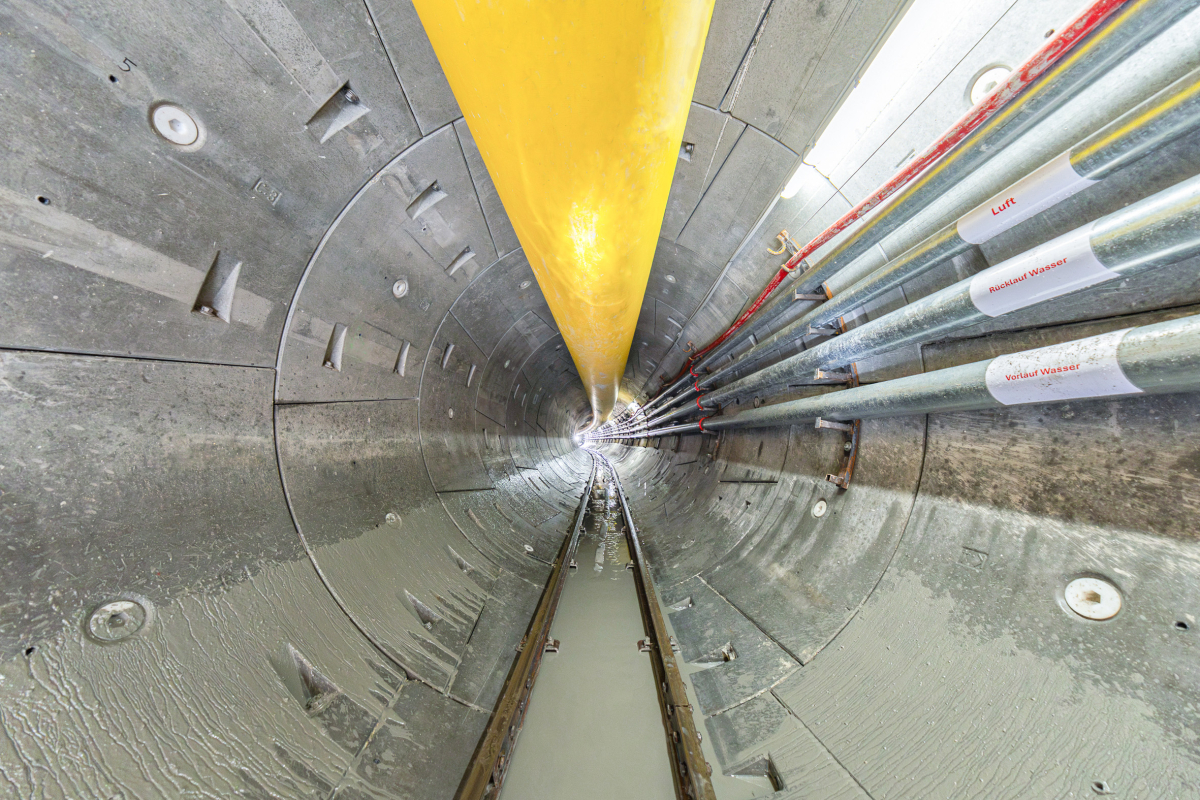


The construction of the Wiental Canal is Vienna‘s largest water protection project to date. It is intended to relieve the existing sewer network during heavy rainfall and improve the water quality of the Wien River. Schöck Combar glass fiber composite material was chosen for the reinforcement in the area of the U2 and U4 subway line crossings. The electrically non-conductive and non-magnetizable material is ideal for use in sections with sensitive measurement technology.
Water Protection Project Worth
270 Million Euros
In the catchment area of the Wien River, sewers dispose of wastewater from twelve districts. However, the Wien River collection sewers are now reaching their limits during heavy rainfall. To relieve the pressure and prevent flooding in the districts, rainwater diluted sewer water is discharged into the Wien River, which affects its water quality. The implementation of the 270 million euro project will enable Vienna to achieve long-term, sustainable rainwater management. The use of Schöck Combar will help to ensure that this forward-looking construction project is successfully implemented even in critical and technically challenging areas of the tunnel.
Start of Tunnelling Work in March 2025
The 8.6 km long sewer, which runs through six districts with an outer diameter of 3.6 m and an inner diameter of 3 m, consists of 7131 segment rings. Since each ring consists of six individual segments, almost 43 000 segments are required, which are being produced at the MABA Fertigteilindustrie GmbH plant, part of the Kirchdorfer Group. The company, based in Wöllersdorf, south of Vienna, has set up a special production facility in its existing halls for this purpose. Production began in October 2024.
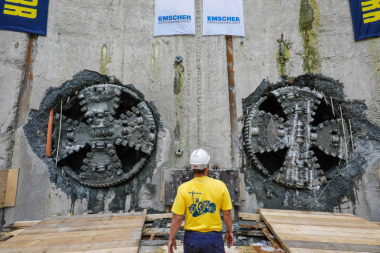
The launch shaft for the exxcavation works was constructed on the Gaudenzdorfer Gürtel. From there, a tunnel boring machine has been working its way through the subsoil since March 2025. The prefabricated reinforced concrete segments can then be installed piece by piece.
Electrically Non-Conductive and
Non-Magnetizable Reinforcement
In addition to classic reinforced concrete, MABA relied on the glass fiber composite material Schöck Combar for the production of the segments. Due to its unique properties, Schöck Combar is a superior alternative to steel for certain applications. In the case of the Wiental Canal, the advantages for tunnel construction with sensitive measurement technology were the deciding factor: the material is electrically non-conductive and non-magnetizable, which means that interference with highly sensitive electrical measurement and control equipment can be ruled out. Schöck Combar was the ideal reinforcement solution for the tunnel areas where measurements are taken.
Crossing of the Subway Lines
This affects two sections in the Pilgramgasse area, where the sewer crosses the U2 and U4 subway lines. A total of eightsegment rings are being installed there. The 48 individual segments required for this were therefore reinforced with glass fibre Schöck Combar elements
instead of steel. An additional argument in favor of using Schöck Combar for MABA was the building authority approval granted by the German Institute for Building Technology (DIBt). This is associated with monitoring by an external testing institute, which equates to reliable, robust quality certification.
Customised Production
Almost the entire range of Schöck Combar products was used in the Wiental Canal project to develop tailor-made solutions such as specially prefabricated, shaping brackets with an outer length of up to 1.5 m or straight bars with and without head bolts and in various diameters.
Planning and production were carried out in close coordination between Schöck Application Technology, the structural engineering office, and the MABA precast plant. Since the individual segments have slightly different geometries, each bar had to be individually dimensioned and calculated. As a result, each head bolt differs from the others in height, depth, and width. Depending on their position in the segment, the shaping brackets also vary in length and degree of bending by a few millimeters. Each bracket has a fixed position in the segment and was manufactured by Schöck with the specified, exact segment radius. The aim was to implement the reinforcement requirements in a customer-friendly and processing-friendly manner.
Fabian Marlok, Head of Product Management Combar, Isolink, Sconnex, and Signo at Schöck, comments: „With orders like this, everything has to be custom-made. And we are faced with increased requirements in production. Unlike reinforcing steel, which can be easily bent and retains its shape, glass fiber rods tend to spring back into a straight line. The big challenge for Schöck was to produce shaping brackets for these material properties in order to make further processing as easy as possible for the customer.“
Efficient Prefabrication
The prefabrication, which was accurate to a tenth of a millimeter, allowed for efficient assembly of the reinforcement cages, which was carried out manually in the precast plant. The brackets and straight bars could be easily assembled without any additional work. The different reinforcement elements were bundled by Schöck according to type and delivered with clear labeling. The exact assignment of the individual elements was easily possible using the parts list on the plans. Nevertheless, a high level of technical expertise was required for correct execution. The finished cages were then placed in the formwork device during the further production process, into which the concrete was subsequently poured.
High Quality Requirements
The manufacture of tunnel segments is subject to high quality requirements, combined with extremely low tolerances. For this reason, each individual segment is checked meticulously for precise geometry after removal from the formwork before acceptance. “It worked,” confirms Norbert Stricker, project manager at Kirchdorfer. He is not only satisfied with the result, but also emphasizes the good cooperation with Schöck in collaboration with the other parties involved.