From Spoil to Construction Material: Turning Soil and Rock Into a Sustainable Cement Substitute
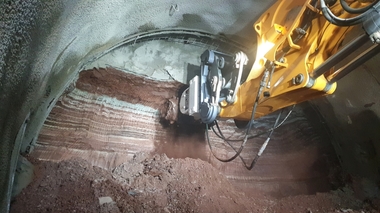
Every year, millions of tonnes of excavated material are generated during tunnelling and underground construction projects. To date, most of this material has been disposed of in landfill sites without further use. The interdisciplinary research project Geo-BAB is investigating how such clay mineral-rich materials can be transformed into a low-CO2 alternative to conventional cement through thermal treatment and chemical activation.
More Than Four Million Tonnes of Excavated Material Every Year in Germany
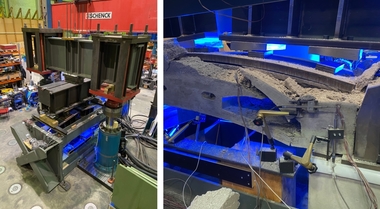
 Calcined clays, natural sand, cement and water as investigated in the preceding research project
Credit/Quelle: Benedict Bremert, TH Köln
According to STUVA statistics, tunnel construction projects in Germany alone generate more than four million tonnes of excavated material every year. While hard rock can be reused, for example as aggregate in concrete, the utilisation of cohesive soils such as silts and clays is considerably more challenging. To develop a sustainable solution for these materials as well, the research project is focusing on the process of calcination. In this process, clay-rich material is dried, ground and heated in a kiln. This thermal treatment alters the structure of the clay minerals, making them reactive and capable of acting as a binder. The consortium, comprising the two research institutions STUVA e. V. and TH Köln, together with the three industry partners IMM Maidl & Maidl Beratende Ingenieure GmbH & Co. KG, Brameshuber + Uebachs Ingenieure GmbH and MC-Bauchemie Müller GmbH & Co. KG, combines expertise in construction materials technology, mineralogy, geotechnics, chemistry and civil engineering.
Two Pathways to Low-Carbon Binders
To unlock the potential of these calcined clays, the partners are pursuing two technological approaches. In low-clinker cement systems, the treated material is intended to replace a proportion of conventional cement clinker. Of particular interest is determining the percentage of clinker that can be substituted by calcined clay without compromising performance. As cement production is responsible for around eight per cent of global greenhouse gas emissions, according to the German Environment Agency, this substitution approach can significantly reduce the CO2 footprint of concrete. At the same time, the consortium is also investigating entirely cement-free binders. In these systems, strength development is initiated by so-called activators, such as water glass (sodium silicate), a mineral-based compound. The result is an alternative binder that represents a particularly resource-efficient solution for the construction industry.
From Laboratory Samples to a Mobile Calciner
As part of the Geo-BAB project, various unconsolidated and hard rock materials from Germany’s low mountain ranges, metropolitan regions and major international construction sites are being investigated.
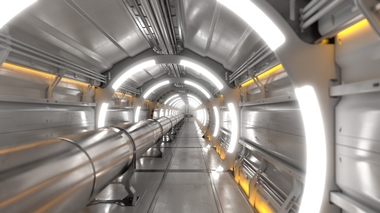
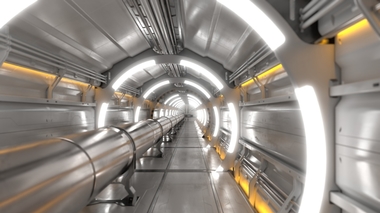
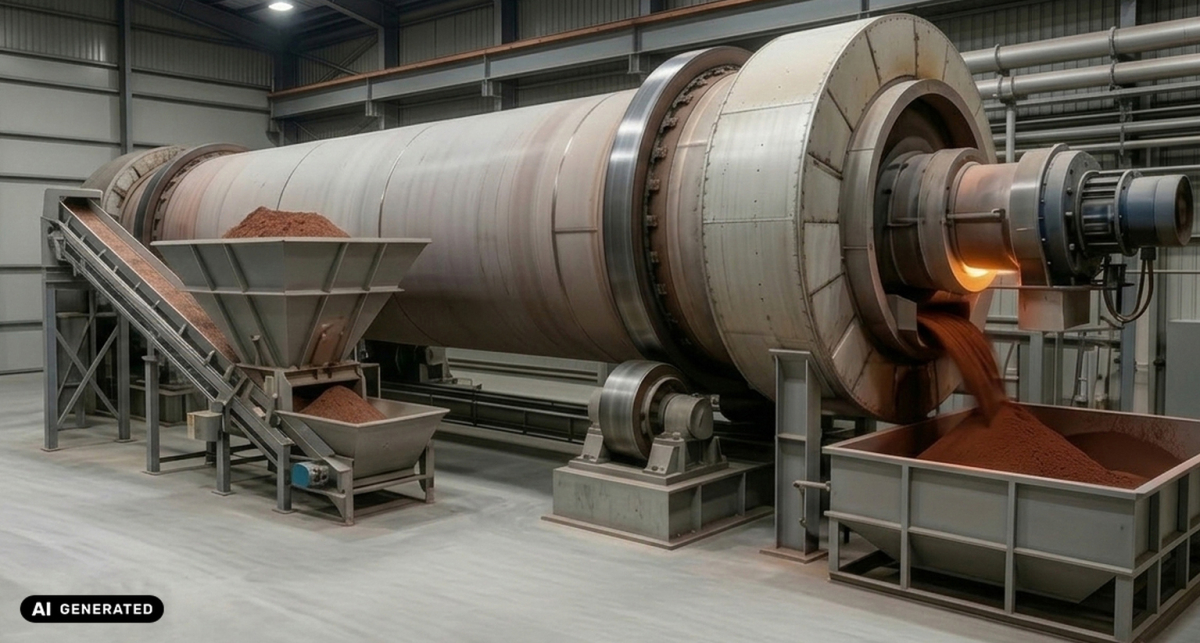 Visualisation of a calciner as it could be deployed within the project
Credit/Quelle: AI-generated illustrative image | STUVA
The materials are first characterised and their strength development assessed under laboratory conditions. In parallel, the project is examining how the technology can be implemented in practice. For this purpose, a mobile calciner is planned to be deployed directly on site, enabling material processing at a technically relevant scale on construction projects. The potential applications of the new binders derived from tunnel excavation material are wide-ranging. They include use in tunnelling itself, for example in annular gap grouts between the tunnel lining and the surrounding ground. Other potential applications include concrete paving blocks for landscaping projects and ballast concrete for hydraulic engineering works.
About the Geo-BAB Project
The collaborative project Geo-BAB (Calcination of Geological Secondary Raw Materials from Tunnel Construction for the Production of Alternative Binders) is being funded with approximately 650 000 euros for a period of two years by the German Federal Highway Research Institute (BASt) under its Road Innovation Programme (“Innovationsprogramm Straße”).