Construction Begins on the Pfaffensteig Tunnel – Scheduled To Become Operational in 2033
On 12 October 2026, Deutsche Bahn, together with its many partners, marked the start of construction on the Pfaffensteig Tunnel with a symbolic ground-breaking ceremony. From 2033, it will connect the Gäubahn – running to and from Zurich – with the Stuttgart 21 infrastructure.
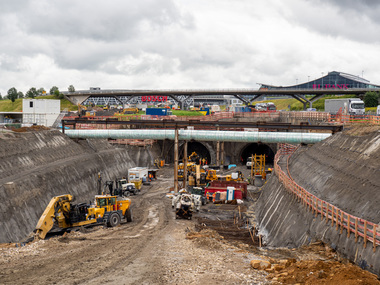
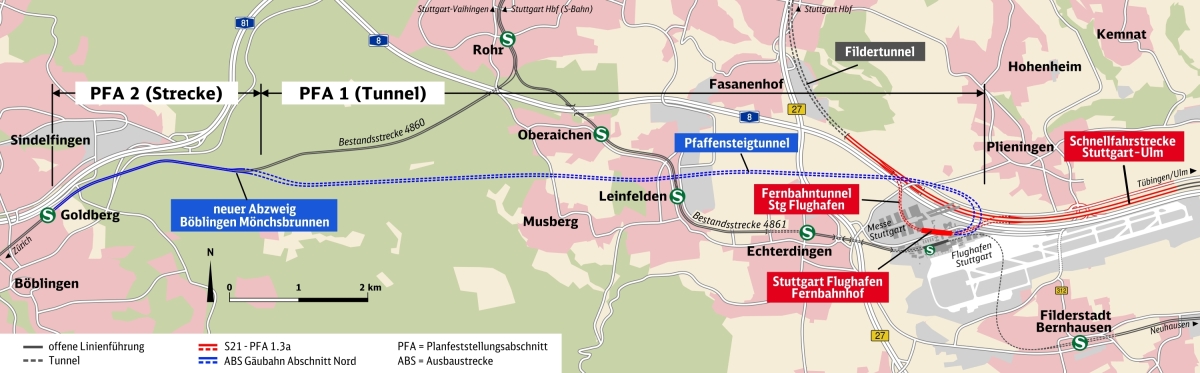 Construction work on the approx. 11 km-long Pfaffensteig Tunnel began in October 2026
Credit/Quelle: DB Projekt Stuttgart–Ulm GmbH
A particular characteristic of the construction of the approximately 11 km-long tunnel and the subsequent approximately 3 km-long railway line between the tunnel and Böblingen is that the new infrastructure is being realised under the so-called “Rail Partnership Model”. Within this model, Deutsche Bahn and its alliance partners plan and build everything together from day one and also share responsibility for the timetable and cost.
Rail Partnership Model
Stefan Kratochwill, Chairman of the Executive Board of Strabag SE: “The Pfaffensteig Tunnel is a project that places the highest demands on planning, coordination and construction. The start of tunnelling marks the transition from in-depth joint planning to the visible implementation phase. Together with Deutsche Bahn and our partners, we are relying on state-of-the-art tunnelling technology, digital planning methods and a partnership-based approach to project management.”
The aim of the Rail Partnership Model is to complete complex large-scale projects more quickly and cost-effectively. In contrast to the conventional approach previously taken for large-scale projects, Deutsche Bahn, together with its alliance partners FCP, Geoconsult, Hörmann, iC-Consulenten, Rhomberg Bahntechnik, Spitzke, Strabag, Swietelsky, Wayss & Freytag and Züblin, has drawn up a cross-trade schedule in addition to the design and approval planning. Time and budget risks were jointly identified, assessed and factored into the schedule and cost framework.
Pfaffensteig Tunnel Links the Gäubahn With Stuttgart 21
The expansion of the Gäubahn – and thus also the construction of the Pfaffensteig Tunnel – is listed as a priority in the German Federal Rail Network Development Plan. Consequently, as part of the Federal Rail Network Expansion Act, the Pfaffensteig Tunnel is in the ‘overriding public interest’. The construction of the project was agreed between the Federal Government and DB InfraGO AG at the end of 2025; preparatory construction work began on 9 February 2026.
The Pfaffensteig Tunnel will connect the Gäubahn to the airport and, further on, to the future Stuttgart Central Station. The tunnel thus also fulfils a significant part of the financing agreement concluded by the Stuttgart 21 project partners.
The tunnel will enable a journey time between Stuttgart and Zurich that is around 15 minutes shorter. This will also improve connections along the route. Many passengers will also benefit from the journey time between Böblingen and the airport being reduced from the current 22 minutes to around 7 minutes in future. Furthermore, passengers travelling on the Gäubahn will be able to change conveniently at the airport onto fast services towards Ulm and Munich – and vice versa.
10.8 km of Conventional Tunnel Construction
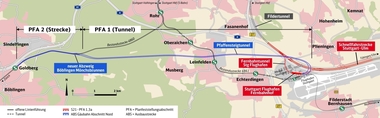
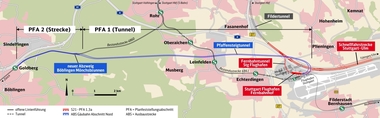
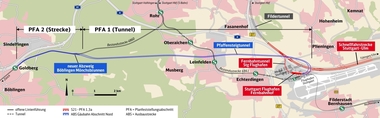
The planning for the Gäubahn North Extension project, including the Pfaffensteig Tunnel, is divided into sections. The planning permission granted for Planning Approval Section (PFA) 1 at the end of 2025 covers the 10.8 km section of the Pfaffensteig Tunnel to be constructed using conventional methods. PFA 2 comprises the approximately 300-metre-long section of the Pfaffensteig Tunnel to be constructed using the cut-and-cover method, followed by the approximately 3-kilometre-long above-ground section of track leading to the Goldberg S-Bahn station, situated between Böblingen and Sindelfingen. Deutsche Bahn submitted the planning approval documents for the second project phase to the Federal Railway Authority (EBA) in April 2025. The symbolic start of construction on 12 October took place at the future emergency access tunnel of the Pfaffensteig Tunnel. Passengers are expected to be able to use the new tunnel from 2033 onwards.