STUVA Conference 2025 in Hamburg: Three Days of Innovation and Sustainability
Exhausted but happy – that was the prevailing feeling among most participants at the STUVA Conference 2025 in Hamburg. As anticipated, the three days from November 25 to 27, 2025, at the Congress Center Hamburg were exceptionally intense: All exhibition space at STUVA Expo, covering approximately 7000 m², was allocated in no time at all, and the number of conference participants had been breaking records since the early registration phase. In the end, about 4400 people participated in the world‘s largest conference and trade fair for tunnels and infrastructure. For three days, participants focused on major current issues facing the industry: sustainability and CO2 reduction, digitalization and BIM, safety and availability, energy corridors and urban mobility – all with the familiar atmosphere that makes the STUVA Conference held every two years something very special.
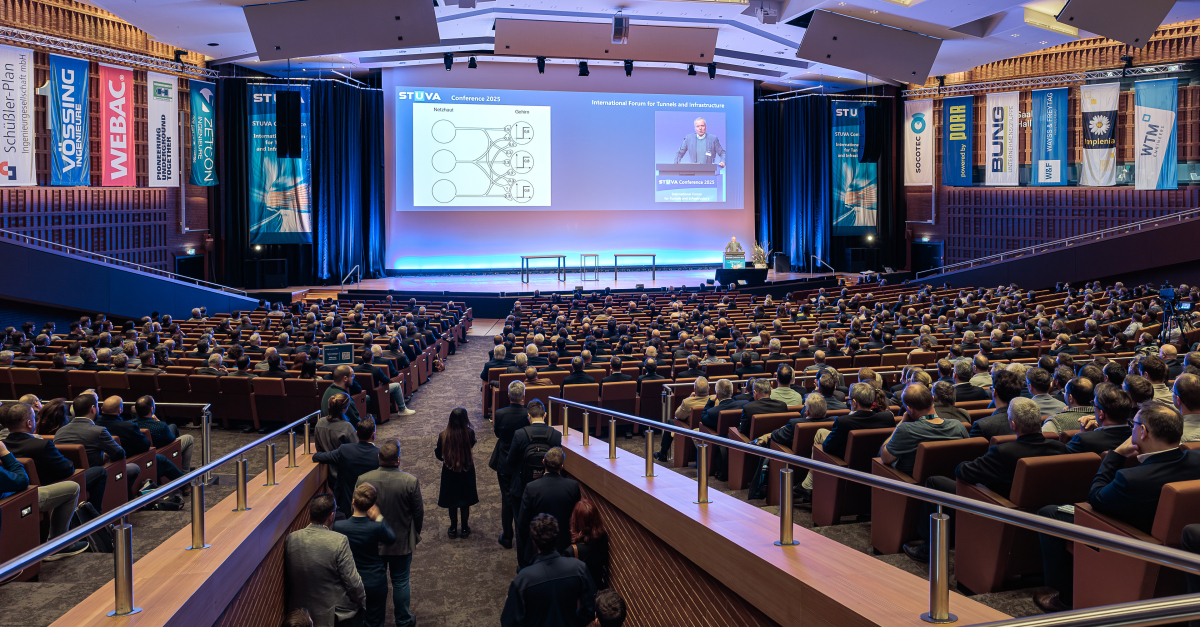 The perfect mix! In 2025, the three-day STUVA Conference once again attracted the industry with numerous presentations and a vibrant trade exhibition: 4400 participants set a new attendance record
Credit/Quelle: STUVA
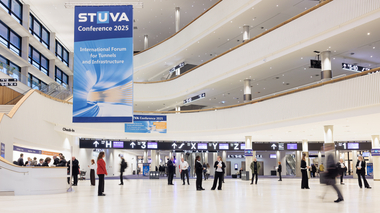
The CCH Awakens – and with it the Tunnelling World of the STUVA Conference
Tuesday morning in Hamburg, just before 9 a. m. Outside, dawn has barely broken, yet thousands of participants are already streaming toward the Congress Center Hamburg for the STUVA Conference 2025. Two years of waiting have finally come to an end. At exactly 9 a. m., STUVA’s outgoing Chairman of the Board, Univ.-Prof. Dr.-Ing. Martin Ziegler, steps onto the stage in Hall 1 and opens the conference with a view beyond the horizon: Hamburg as the “Gateway to the World,” a city of progress, tolerance, and openness – the perfect place not only to discuss the future but to put it on track. And those who know the industry understand that it’s no longer just about new construction using cutting-edge technology; it’s equally about upgrading and operating existing infrastructure – robust, efficient, and above all resource-conscious. Because the fight against man-made climate change can only be won one way – through sustainable engineering and people who work on our shared future with expertise, courage, and vision.
The subsequent greeting from Dr. Anjes Tjarks, Hamburg’s Senator for Transport and Mobility Transition, arrives as a video message rather than in person, but its message is clear: Hamburg is delighted to host the STUVA Conference as the city is committed to sustainable mobility. Among many major infrastructure projects, Hamburg is currently building Germany’s most advanced metro line – fully automated, environmentally sound, and broadly supported by its citizens. The U5 is not just any project; it represents Hamburg’s mobile future. These shared goals unite the Hanseatic city and STUVA. The conference could not be more welcome here!
Insightful Keynote Speech: “AI is Already Ahead of us…”
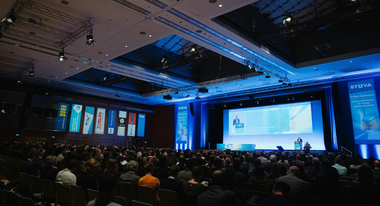
 The real star of every STUVA Conference is the expert audience: Speakers here reach exactly their target group – and enjoy undivided attention
Credit/Quelle: STUVA
 Cutting-edge presentation technology at the STUVA Conference once again delivered a flawless experience
Credit/Quelle: STUVA
Some presentations can define a conference – such as the opening keynote by Prof. Dr. med. Dr. phil. Manfred Spitzer: “Artificial Intelligence Is Already Ahead of Us. Will It Make Engineers Obsolete Tomorrow?” – a provocative question that framed his talk. Spitzer demystified the current hype around “AI” without diminishing its significance: for him, AI does not simply mean algorithms in the sense of rigid logic, nor “intelligence” in the human sense – but rather a kind of “machine intuition” that uncovers hidden patterns in vast datasets. There are plenty of examples: complex, non-computable games, deciphering cuneiform, protein folding, even brewing beer. Wherever patterns lie concealed, AI excels – often more than we do. But is it a threat to the engineering profession? Spitzer’s conclusion is both reassuring and challenging: AI will not replace experts, but experts who fail to embrace AI will – in almost every field – be replaced by those who do. For the tunnelling industry, this means engineers of flesh and blood will remain indispensable, but they must not shy away from using artificial intelligence as a powerful tool.
Parallel Sessions for Tunnel Construction and Tunnel Operation – Two Halls, one Common Focus
After Prof. Spitzer’s keynote, participants split into parallel sessions – and it quickly became clear how strong the interest in both fields was. Two halls, different focal points, but one common goal: shaping the future of underground construction and operation.
The tunnel construction sessions initially spotlighted major projects: railway tunnels, energy corridors, and new utility tunnels emerging as critical infrastructure. Later, the focus shifted to sustainability and CO2 reduction – not as a buzzword, but as a tangible engineering challenge. Discussions ranged from the reuse of excavated material to the potential of geothermal energy and the role of steel fiber reinforcement in resource-efficient linings. Attentive listeners realized: this is about more than technology – it’s about a new self-concept for tunnelling, combining efficiency with environmental responsibility and embracing every technical innovation available.
The tunnel operation sessions were equally well attended. Topics spanned safety and risk mitigation, tunnel availability, and ventilation concepts – such as dew point control in the Saukopf Tunnel or cooling strategies for the Future Circular Collider in Geneva. Overarching all was the theme of digitalization: BIM, digital twins, AI-driven information processing, and robust communication networks.
A common thread linked both sessions: sustainability and energy. Decarbonizing cement and concrete, ecologically assessed tunnel linings – these were not side issues but integral to strategic planning.
STUVA Prize Goes to Hamburg’s U5 Project
 This year’s prestigious STUVA Prize went to Hamburg’s forward-looking mobility project U5 (from left to right): STUVA Managing Director Prof. Dr.-Ing. Roland Leucker; Dipl.-Ing. Jens-Günter Lang, Board Member for Technology at Hamburger Hochbahn AG;
Klaus Uphoff, Managing Director of Hochbahn U5 Projekt GmbH; and Univ.-Prof. Dr.-Ing. Martin Ziegler, former Chairman and now Honorary Member of the STUVA Board
Credit/Quelle: STUVA
The STUVA Prize 2025 went to Hamburg’s U-Bahn project U5. With this prize, STUVA honored a project that exemplifies forward-looking mobility, sustainable construction, and collaborative partnership. As Germany’s largest metro project, U5 will create a powerful east-west link spanning roughly 25 km with 22 stations. Its fully automated operation at 90-second intervals will establish vital new connections within the city’s transport network, offering up to 315 000 passengers per day fast, accessible, and reliable mobility.
Environmental protection is a top priority in this flagship project, with CO2 emissions embedded as a key evaluation criterion from planning through execution. U5 sets new benchmarks for ecologically responsible, low-emission infrastructure. For the first time in Germany, steel fiber-reinforced segments will be used in this project. Combined with low-emission materials, optimized construction methods, and rigorous CO2 monitoring, the new metro line will become a cornerstone of Hamburg’s climate protection strategy.
Young Forum: Exciting Lecture Competition Among Emerging Engineers
 Dr. Gabriel Lehmann, winner of the “Young Forum” presentation competition, receives a trip to the Snowy Hydro project in Australia along with his certificate
Credit/Quelle: STUVA
Late Tuesday afternoon, the stage belonged to the next generation: five young professionals presented their own projects in the “Young Forum” and faced the verdict of an expert audience. It was no easy choice – all five candidates delivered impressively prepared talks. Julia Middendorf, Simon Böhmer, Robin Senyüz, Annika Stopp, and Dr. Gabriel Lehmann competed with highly engaging presentations. In the end, Dr. Gabriel Lehmann, Head of Geotechnics at Herrenknecht AG, prevailed. His well-rounded lecture on “TBM Excavation in Hard Rock: Rock Preconditioning with Microwaves” captivated the audience. The concept: utilizing selective heating to create micro- and macro-cracks in the rock, significantly weakening and pre-damaging it. In test campaigns with over 1500 samples, strength was reduced by up to 60%. Theoretically, this could boost advance rates and reduce wear.
 From early morning until late in the evening, the STUVA Expo was a true crowd puller
Credit/Quelle: STUVA
“I’ve Been Talking Nonstop for Two Days. Wonderful!”
Alongside the presentations, the STUVA Expo was buzzing in Hall H, directly adjacent to the CCH, covering around 7000 m². Here, 182 exhibitors showcased what they have to offer the industry – from machinery manufacturers to specialist foundation engineering and service providers. For two days, the hall buzzed like a beehive. Everywhere you looked, people were engaged in conversation – nonstop for two full days. At times, it was almost impossible to get through the crowds; yet the smiles remained on people’s faces, as this many customer contacts can only make them happy. One exhibitor summed up the mood of the conference at the STUVA counter: “I’ve been talking nonstop for two days. Wonderful!”
With high demand for space, securing a booth was not guaranteed. Some interested companies had to be deferred to the next trade fair in two years’ time in Munich.
STUVA-YEP Back with its own Booth
 The newly elected YEP Steering Committee, joined by fellow STUVA-YEP members at their own booth
Credit/Quelle: STUVA
Naturally, the STUVA Forum for Young Engineering Professionals (STUVA-YEP) was once again present with its own booth at the Expo. Founded only in 2017, this young professionals’ organization has achieved a great deal in its eight years and continues to grow rapidly. Today, it counts around 470 registered members – and rising. Through regular events such as workshops and site visits, STUVA-YEP provides a platform for networking and exchanging experiences, both professionally and personally, among young engineers. New members are always welcome. Membership is free and open to aspiring professionals in German tunnelling or related sectors up to the age of 35 (those interested can simply send an email to ).
 1The gala evening on the first day was completely sold out, with over 2000 guests in attendance
Credit/Quelle: STUVA
Gala Evening: Champagne Reception, Full House, and Keller Bar Until Late
As evening fell, the rhythm changed. First, there was a stylish champagne reception hosted by Socotec in the impressive CCH foyer, before the gala dinner began – fully booked, with an atmosphere blending relaxed sociability and professional exchange over a fine meal. And because traditions endure at STUVA, the legendary Keller Grundbau bar opened later. Some discussions work best in the morning, others deepen at night; Hamburg offered both.
Day Two: Packed Halls Despite a Short Night
Anyone worrying that the long evening would subdue energy levels the next morning was proven wrong. On Wednesday, both lecture halls were well attended early on. The mechanised tunnelling session kicked off with insights into spectacular projects: the Woodsmith Mine (long TBM drives, deep steel-lined shafts), the Brenner Base Tunnel (comparing exploratory adits with main tunnel tubes), and variable-density machines with small diameters (Ibbenbüren) and large ones (Hampton Roads Bridge Tunnel).
Meanwhile, in the tunnel operation session, the digital thread was spun further: BIM, digital twins, AI – but with a practical focus. Topics included real-time information processing, robust communication networks, and lessons learned across project phases – not just tools, but processes. Later, fire protection and emergency management took center stage: DAUB recommendations, group evacuation trials, analytical proofs per ZTV ING. This was the kind of program that sparked ideas – for guidelines, planning, and construction sites.
In the afternoon, the spotlight returned to Hamburg, both regionally and strategically: underground construction in the city with U5 Mitte and U5 Ost, TBM launch structures, diaphragm walls, and underwater concrete; plus ElbX with 4.8 bar hyperbaric conditions and safety measures, and the district heating tunnel under the Elbe with an EPB TBM. Hamburg showed what it can do – when approached with foresight: complex construction, tight schedules, and orchestrated interfaces.
 After 22 years, Prof. Dr.-Ing. Martin Ziegler (left) handed over the symbolic “scepter” (the segment dowel) as Chairman of the Board of STUVA. Newly elected Chairman is Dipl.-Ing. Tim Dahlmann-Resing, Vice President of VDV and Managing Director for Technology at VAG Nuremberg
Credit/Quelle: STUVA
Then suddenly it was 6:00 p.m., and the presentations were over. The last talk, the last thought. Now it’s back to waiting two years – until the next conference. One person, however, received the final applause: Univ.-Prof. Dr.-Ing. Martin Ziegler is stepping down after 22 years as STUVA’s Chairman of the Board. Of course, at STUVA, one never really leaves, so he will remain an honorary board member. His successor is Dipl.-Ing. Tim Dahlmann-Resing, a long-standing board member who knows STUVA inside out. An experienced practitioner, he will assume the role of host at the next STUVA Conference. The STUVA team thanks Prof. Ziegler for his many years of warm leadership and wishes Mr. Dahlmann-Resing great joy and success in his new role.
Day Three: Hands-On Technology – In-Depth Excursions
 U4 extension Horner Geest: Dirk Göhring, Head of Subway Construction at Hochbahn, insisted on personally accompanying his colleagues to “his” construction site
Credit/Quelle: STUVA
 During the DESY/XFEL excursion, participants were even allowed into the actual experimental tunnels of the particle accelerator – equipped with dosimeters and transponders
Credit/Quelle: STUVA
After two days of exhibition halls and lecture rooms, the third day brought a complete change: off with the business suit, on with the boots! Carefully curated technical excursions awaited those lucky enough to secure one of the coveted spots. Participants enjoyed exclusive tours of major construction sites and projects – some in areas normally off-limits – always guided by project managers, many of whom had attended the conference themselves. Highlights included the final structural works of the U4 Horner Geest extension, the first sites of the U5 mega-project, the XFEL/DESY particle accelerator, the segment tunnel of the ElbX crossing as part of SuedLink, and more. The most elaborate tour, with a 2.5-hour bus ride, took participants to the Fehmarnbelt Tunnel megaproject, visiting both the German and Danish construction sites. When this group returned to Hamburg in the evening, the 2025 STUVA Conference was officially over.
A Heartfelt Thank You to All Sponsors and Supporters of STUVA 2025!
As in previous years, the STUVA Conference 2025 was supported by numerous companies and organizations. Special thanks go to all sponsors for their committed and reliable support. STUVA also warmly thanks the exhibitors for their participation in the STUVA Expo and the companies that provided participants with practical and highly exclusive insights during the excursions. Particularly noteworthy is the sponsorship of tickets for students from Hamburg universities, initiated and organized by STUVA-YEP. Thanks to the generosity of several companies, many students were able to attend the conference free of charge this year. We extend our sincere thanks –
also on behalf of the next generation of professionals.
After STUVA 2025 Comes STUVA 2027
As always, the three days of the STUVA Conference in Hamburg flew by. Now it’s time to return to day-to-day business and start developing new topics for the next conference. Fortunately, the location and date are already set. For everyone who can’t wait: the next STUVA Conference will take place in Munich from 8 to 10 December 2027 at Messe München. We look forward to continuing the professional exchange and are already excited about STUVA 2027 in Munich – save the date!