11th Rock Mechanics and Tunnelling Day
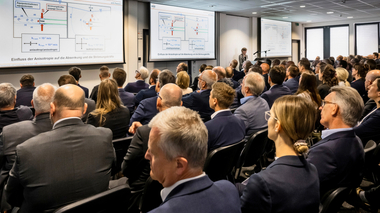
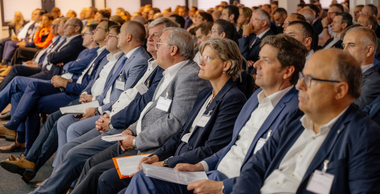
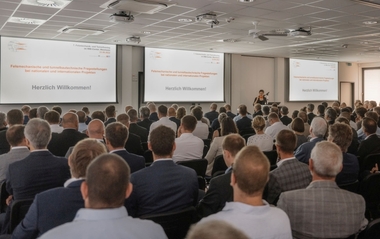
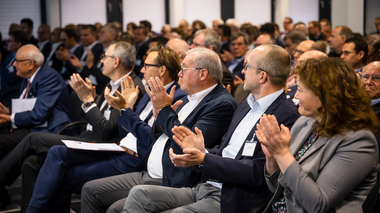
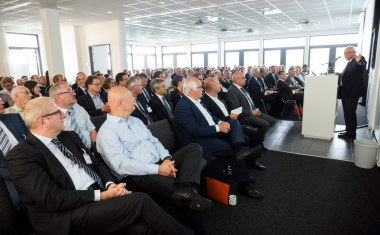
On June 11, 2026, the 11th Rock Mechanics and Tunnelling Day took place at the WBI Center in Weinheim, Germany. This year’s well-attended conference focused on the topics “Innovations in Tunnel Construction,” “Current and Future Projects of Deutsche Bahn,” and “Future Hydraulic Engineering Projects and the Energy Transition”. The Event isorganized annually by WBI GmbH, sponsored by the German Railway (DB InfraGO) and supported by the German Engineering Association (Arbeitskreis Bautechnik of the Württembergische Ingenieurverein).
Opening Presentation
The opening presentation, titled “Strategy and Medium-Term Objectives of DB InfraGO AG,” was delivered by Gerd-Dietrich Bolte, Dipl.-Kfm., Executive Board Member for Infrastructure Planning and Projects at DB InfraGO AG. He described the advantages of the corridor-based renovation concept over conventional renovation methods. Instead of constant short-term closures – which generally also cause bottlenecks in ongoing rail traffic – comprehensive corridor renovations are to be implemented starting in 2027, with the aim of reducing closure times by a factor of 7 and enabling long intervals free of renovation work: “five to eight years with only minor maintenance measures.” By 2028, two corridor renovations per half-year are planned, with construction phases determined well in advance, followed by periods completely free of construction work to allow for better planning.
In addition, “a real technological leap” is set to be made shortly with the digitization of signal box technology. Digital control centers will replace the old signal boxes, and more than 50 data centers will be built across Germany to support digital control. The expansion and new construction of rail infrastructure through 2035 were also discussed. This includes “a great many tunnels.” Because, as Bolte put it, “if you only invest in the existing infrastructure, you’ll have a good infrastructure, but not one that’s positioned for the future.”
Innovations in Tunnel Construction
Dipl.-Ing. Ulrich Bergerhausen from the Federal Highway and Transportation Agency opened the first session. He described current developments in structural fire protection for road tunnels—a construction safety measure of the utmost importance, as tunnel fires are considered extreme stress scenarios in which maximum temperatures of up to 1200 °C can occur. Based on fire tests, two new ZTV-ING-compliant concrete mixes were developed that exhibit low spalling tendency in the event of a fire and good durability properties. In addition, it was demonstrated for the first time that light-colored coating systems do not negatively affect the fire behavior of inner tunnel linings.
Dipl.-Ing. Sandra Katz and Dipl.-Ing. Uwe Kneißl of DB InfraGO AG gave a presentation on the topic of new construction versus maintenance of existing DB railway
tunnels. According to the speakers, the challenge of maintaining existing infrastructure will become increasingly significant in the medium term. Currently, 80 percent of railway tunnels are classified in the two best condition classes, 1 and 2, while only one percent fall into the worst condition class, 4. The forecast for 2042, however, indicates that 18 percent of tunnels will then be rated as “class 4.” This would mean that 130 of DB’s total of 760 existing tunnels would be in critical condition. To address this, the sustainable preservation of the tunnel infrastructure requires a balanced combination of repairs, partial rehabilitation, and complete rehabilitation. “We don’t want this forecast to come true,” said Sandra Katz. Given the limited funds available, early maintenance is particularly important, as it represents a more cost-effective way to extend the service life of the tunnel structures.
Three additional presentations in the first session focused on steel-fiber-reinforced concrete – a building material that can help reduce CO2 emissions in tunnel projects. According to session chair MR Prof. Dr.-Ing. Gero Marzahn, these presentations provided “impetus for implementing this method in Germany as well.”
Dr.-Ing. Martin Wittke spoke about the generally positive experiences 20 years after the Carmel Tunnel in Haifa, Israel, was designed and constructed using the single-shell construction method with steel-fiber-reinforced sprayed concrete. Further presentations addressed the use of steel-fiber-reinforced segmental lining in London-based tunnel projects and the current state of research and application in Germany regarding the use of steel-fiber-reinforced concrete in mechanised tunnel construction.
Current and Future Projects
of Deutsche Bahn
Four presentations focused on Deutsche Bahn’s current and future projects. Jörg Ritzert, Dipl.-Ing., from DB InfraGO AG, began by providing a clear explanation of how the tunnelling methods are determined for the construction of three tunnel sections—using both open-cut and underground methods with a tunnel boring machine (TBM)—on the new Frankfurt–Mannheim line. The project is currently in the planning phase for approval.
Ritzert then gave a joint presentation with Dr.-Ing.
Bettina Wittke-Schmitt on the influence of ground conditions on route selection for the tunnels on the new and upgraded Fulda–Gerstungen line. Challenges in tunnel construction in inner-city areas were described using the example of the Wartberg Tunnel (part of the P-Option in Stuttgart)—including tunnelling beneath the foundation piles of the historically protected Brünner Steg and beneath active rail tracks.
Dipl.-Geol. Albert Wimmer and Dr.-Ing. Patricia Wittke-Gattermann focused on the major 2nd Munich–S-Bahn Main Line project. They reported on the experiences with compressed-air tunnelling for Rescue Shaft 3 – particularly with regard to future planning and construction under similar conditions and using similar advance methods (compressed-air tunnelling with groundwater dewatering in loose rock).
Future Hydraulic Engineering Projects
and the Energy Transition
The first presentation in the closing session addressed the renovation of existing facilities as well as new construction projects by Schluchseewerk AG. For a supplementary headwater channel in hard rock, an optimized geotechnical investigation with integrated analysis of existing data was conducted, which reduces the scope of exploration while simultaneously improving the quality of forecasts. Following this, a report was presented about the planning of a 5-km-long adit to the Wehebachtalsperre dam in the Eifel region, which is intended to supply raw water from a neighboring watershed for drinking water production. The planning approval process began in early 2026; construction is scheduled to begin in mid-2027.
Save the Date
The date for the 12th Rock Mechanics and Tunnelling Day has already been set: it will take place on June 24, 2027 at the WBI Center in Weinheim.