Hamburg’s U5 Subway Line: Tendering and Award Criteria for Sustainability Requirements
The decarbonisation of major infrastructure projects is a key factor in achieving climate targets in the transport sector. Public clients can contribute to this by incorporating sustainability criteria into their tendering and award conditions. Such measures can create incentives to use lower-emission building materials and construction methods, whilst also improving transparency in supply chains. Using the example of Hamburg’s U5 subway line, this article shows how sustainability can be integrated into procurement processes step by step, in compliance with public procurement law. The focus is on criteria for reducing greenhouse gas emissions (GHG emissions) and for addressing environmental and social risks, particularly within steel and concrete supply chains.
1 Overview and Key Issues for Infrastructure Projects
 1 | The pioneering project of the Hamburg U5 subway line showcases the importance of integrating a sustainability strategy at an early stage and in a practical manner at all levels of the construction project
Credit/Quelle: Hochbahn U5 Projekt GmbH
Large-scale infrastructure projects have a significant impact on the climate due to their high consumption of materials and energy. Steel and concrete, in particular, account for a substantial proportion of construction-related greenhouse gas emissions. Their supply chains are often global in scope and complex, which places increased demands on transparency and traceability.
In previous tendering procedures for engineering and construction works, the focus has predominantly been on costs, schedules and technical functionality. Where sustainability aspects were taken into account at all, they were usually limited to general requirements and had only a limited impact on steering the process. In particular, there was a lack of effective incentives for the use of lower-emission materials and construction methods, as well as for greater transparency in supply chains.
Against the backdrop of stricter climate targets, regulatory requirements regarding corporate due diligence and the increasing availability of suitable products, there is increased demand for change. Large-scale projects such as the U5 in Hamburg can act as catalysts by having the client define verifiable requirements regarding emission indicators,
origin and supporting documentation. Procurement and award criteria are key instruments in this regard for integrating sustainability more effectively into procurement processes and supporting market-driven developments.
The following approaches, as exemplified by the U5 project, demonstrate how practical implementation can succeed despite challenges relating to integration in compliance with public procurement law, as well as ensuring transparency and competition (Fig. 1).
2 Public Procurement Law and Strategic Framework
The integration of sustainability requirements into planning and construction works is achieved primarily through the tendering and procurement process. The applicable public procurement law already provides a robust framework for systematically incorporating additional environmental and social considerations into procurement processes. The integration of sustainability is not only a permissible but also a required procurement objective, particularly against the backdrop of national climate protection targets and growing regulatory requirements regarding supply chains and resource preservation [1, 2].
In principle, public contracting authorities have various instruments at their disposal to embed sustainability requirements in line with public procurement law, even within traditional procurement procedures. A broad distinction can be made between mandatory and incentive-based measures.
Mandatory measures serve to set specific minimum requirements for a service and to ensure a defined level of ambition for sustainability. These may be specific overarching requirements set out in the bill of quantities
regarding materials, construction methods or energy consumption. In addition, selected (additional) requirements for specific materials and services can be incorporated into the individual positions in the bill of quantities.
Incentive-based measures, on the other hand, allow a bidding party‘s particular commitment to implementing improved sustainability measures to be recognised. These measures do not therefore have to be met by all bidders, but should lead to an advantage for those bidders, particularly where these measures would otherwise place them at a disadvantage due to acceptable additional costs. These instruments include, amongst others, monetisation methods such as the CO2 shadow price (see 5.1 for an explanation) or the use of particular award criteria which allow for more environmentally friendly construction methods and processes, or social criteria (such as a high level of supply chain transparency), to be factored into the tender evaluation.
To ensure compliance with public procurement law, it is crucial that all requirements are clearly linked to the subject matter of the contract, are formulated in a non-discriminatory manner so as to ensure objective equality of opportunity for potential contractors, and are designed to be transparent and verifiable. In particular, when assessing sustainability performance, comprehensible methods and clearly defined means of verification – such as environmental product declarations or standardised calculation methods – are required. This is the only way to ensure that the service offered is genuinely comparable and verifiable.
At the same time, integrating sustainability into procurement procedures requires a strategic approach. Setting minimum requirements defines a binding level of ambition, whilst supplementary award criteria can provide targeted incentives for innovative and above-average solutions. The aim is to reconcile cost-effectiveness, effective competition and ambitious sustainability targets.
The U5 project deliberately makes use of this contractual flexibility under public procurement law to systematically integrate climate protection and supply chain responsibility into the procurement process.
3 Greenhouse Gas Reduction Strategy as an Overarching Objective in the Construction of the U5
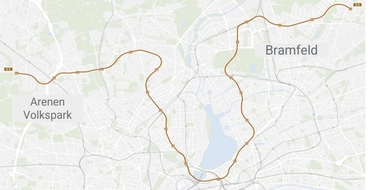
 2 | U5 alignment
Credit/Quelle: Hochbahn U5 Projekt GmbH
 3 | Comparison of GHG emissions in the baseline and target scenario
Credit/Quelle: LPI Ingenieurgesellschaft mbH
With a length of around 29 km and 24 stations, the U5 in Hamburg will, in the long term, shift more traffic onto public transport and reduce emissions in this sector (Fig. 2). The U5 is therefore a key project in Hamburg’s mobility transition. At the same time, the construction of the predominantly underground structures is associated with significant greenhouse gas emissions. Against this background, a comprehensive strategy to reduce construction-related GHG emissions was developed and implemented [3].
The GHG reduction strategy is based on the GHG assessment of a reference scenario that reflects the previously common method of constructing underground railway infrastructure in Hamburg. This enabled the identification of emission hotspots, which serve as starting points for targeted mitigation measures. The measures include, in particular, reducing material quantities, using construction materials with lower GHG emissions, optimising construction processes and methods, and taking into account future technological advances, for example in steel and cement production. The impact of these measures on the GHG balance is summarised in a target scenario. Through consistent optimisation in line with the identified priority areas for improvement, construction-related greenhouse gas emissions can be reduced by around 70 % compared with a reference scenario that reflects how the subway infrastructure in Hamburg has been built to date (Fig. 3).
By identifying emission hotspots, the GHG reduction strategy highlights clear priority areas for improvement and enables a focused approach to implementing the mandatory and incentivising tendering instruments described in the following. The strategy thus forms, amongst other things, the basis for the targeted and effective integration of sustainability requirements into procurement procedures. The resulting current and planned future measures in the U5’s procurement processes are used here as an example.
4 Incorporation of Mandatory Sustainability Criteria in Existing U5 Tender Specifications
By incorporating requirements into the tender specifications, the client has the opportunity to promote sustainability within the market.
The U5 tender specifications therefore set out both general and project-specific sustainability requirements for building materials and methods. These are:
Use of green electricity
Use of FSC-certified (FSC = Forest Stewardship Council) timber products
Use of GHG-reduced transport and site-mixed concrete
Use of clinker-reduced cements for the grout used with the anchors and the grouting suspensions for the jet grouting elements
Coordination of construction processes to facilitate the use of GHG-reduced materials
Requirement that, for open rolled and shaped steels of types I, H, U, T and L, a maximum GHG emissions load of 500 kg CO2-eq./t (up to the point of exit from the steelworks) must be adhered to in accordance with the standard. All specified maximum GHG emissions refer to the calculation in accordance with DIN EN 15804+A2
Specification that a maximum GHG emissions limit of 500 kg CO2-eq./t (up to the steelworks exit) applies to reinforcing steel
All requirements were met by the industry and there were no market restrictions.
 4 | With 400 kg CO2-eq./t (instead of 500) the GHG emissions for steel remained well below the maximum target
Credit/Quelle: Hochbahn U5 Projekt GmbH
In construction lot 2, GHG emissions remained below the specified values, which is why reinforcing steel with a GHG value of 400 kg CO2-eq./t (upon leaving the steelworks) is being used (Fig. 4).
Based on these positive experiences, the requirements for GHG-optimised materials and processes are to be expanded in future tenders. The following will apply going forward:
All construction machinery and equipment will be fuelled with HVO100 (HVO = Hydrotreated Vegetable Oils). To minimise risks to human rights and the environment, criteria regarding the fuel’s origin (Europe) will be defined.
Maximum permissible GHG emissions per cubic metre will be defined for concrete. These range between 110 and 200 kg CO2-eq./m³ (upon leaving the concrete plant) depending on the building component.
Current and future requirements are summarised in Figure 5.
 5 | Current and future project-specific minimum requirements for the U5
Credit/Quelle: Hochbahn U5 Projekt GmbH
Future tenders will impose further requirements on reinforcing steel. To date, GHG emissions have been required to be reported up to the point of dispatch from the steelworks. In future, emissions arising during the transport of steel products to the bending plant and within the bending plant itself must also be reported (Fig. 6). Maximum GHG emissions are defined for the respective process steps. For Module A1, a maximum GHG emission of 400 kg CO2-eq./t
must be adhered to. Modules A2 and A3 may together reach a maximum GHG emission of 100 kg CO2-eq./t.
 6 | Current and future project-specific minimum requirements for reinforcing steel on the U5
Credit/Quelle: Hochbahn U5 Projekt GmbH
Future tenders will also impose more stringent requirements regarding the provision of evidence. Documentation and supply chain registers will be integrated to track compliance with the required maximum GHG emissions for building materials and processes on a batch-by-batch basis. Information on the manufacturers, suppliers and intermediate suppliers of the products is also required.
Further innovations, such as the use of steel-fibre-reinforced segments with an additionally optimised concrete mix design instead of the conventional steel-reinforced variant, are currently being prepared as further tender requirements.
5 Innovative, Incentive-Based Award Criteria To Enhance Effectiveness
If, in addition to the minimum requirements already described, further innovative solutions and building materials or construction processes with significantly reduced GHG emissions are to be promoted, which may only be supplied by a limited number of market participants, additional supportive tendering instruments are required. These include, for example, the CO2 shadow price or supplementary award criteria that benefit bidders who offer more ambitious solutions. This avoids restricting the market for bidders who cannot meet all the requirements. At the same time, bidders demonstrating a particular commitment are encouraged and placed at an advantage during the tendering phase.
5.1 CO2 Shadow Price Methodology
5.1.1 Principles of the CO2 Shadow Price
 7 | Comparison of several evaluation prices from different bidders, comprising the bidding price (aubergine) and the shadow price (green)
Credit/Quelle: Hochbahn U5 Projekt GmbH
Using the CO2 shadow price method, the climate impact of a tender can be incorporated into the evaluation score alongside the actual tender price. To this end, the embedded GHG footprint – for example, from the building materials used – is monetised, and the resulting ‘climate price’ of the tender is added to the tender price (Fig. 7).
The contract is thus awarded to the tenderer who submits the most economically advantageous tender, taking the climate impact into account. To determine the CO2 shadow price, the GHG emissions of a tender must be calculated during the tendering phase and monetised using a defined cost rate for GHG emissions. In this context, the evaluation price Wp and the shadow price Kp can be defined as follows:
(1) Wp = Fp + Kp
Where
Wp = total evaluation score [EUR]
Fp = tender price [EUR]
Kp = CO2 shadow price [EUR]
(2) Kp = mGHG × kGHG
Where
mGHG = mass of GHG emissions contained in the tender [t CO2-eq]
kGHG = cost rate for GHG emissions [EUR/t CO2-eq]
5.1.2 Selection of Materials Included in the Analysis
The monetisation of GHG emissions should be deliberately focused on materials and construction methods that are particularly relevant in terms of emissions, in order to reduce the amount of work involved and the complexity during the tendering phase. Emissions-relevant materials can be identified using a hotspot analysis of the GHG balance. In the U5 project, reinforced concrete, steel products and the production of anchors and grouted elements were identified as emission drivers.
5.1.3 Determining the Monetisation Factor
The monetisation factor determines what level of financial expenditure is appropriate for GHG reduction. Two approaches are commonly used for this:
Market-based comparison of additional costs for lower-GHG materials
Assessment of avoided environmental damage achieved through the use of lower-GHG products
Whilst the first approach requires detailed market knowledge of cost structures within the industry, the second allows for the use of established cost rates that describe the environmental damage that would otherwise have been caused, e.g. in accordance with the Methodological Convention of the German Federal Environment Agency (UBA) [4]. At the same time, they provide a basis for justifying additional expenditure in line with climate policy objectives (see also the Federal Climate Protection Act, Section 13).
In the U5 project, both approaches were compared through market analyses and industry dialogues. Comparable minimum rates were determined for both methods, and the second approach was selected for implementation.
5.1.4 Application Example
The calculation of a bid’s shadow price is described in Table 1. The baseline is determined using the minimum GHG requirements for the products. Bidders have the option of offering binding lower specific GHG potentials, which results in a reduced shadow price.
 Table 1 | Application example
5.1.5 Monitoring Implementation and Proving Compliance
Once the contract has been awarded, the GHG-reduced materials offered become a binding part of the contract (performance target) and must be monitored. The evidence registers described above are used for this purpose. Contractors must submit the agreed product documentation – e.g. Environmental Product Declaration (EPD), Product Carbon Footprint (PCF) – prior to installation to enable verification by the client. Clear penalty mechanisms must be put in place for any deviations.
5.2 Example of Additional Award Criteria: Electric Construction Equipment
 8 | Despite availability still being limited, the use of electric construction machinery helps to reduce emissions
Credit/Quelle: Hochbahn U5 Projekt GmbH
The use of electric construction equipment offers environmental and operational benefits, such as the reduction of GHG, noise and particulate matter emissions. Against this background, Hamburg Hochbahn AG is pursuing the objective of specifically increasing the use of electric construction equipment (Fig. 8).
As the relevant technologies are currently only available to a limited extent, this is managed via an additional award criterion: the proportion of electric construction equipment offered in relation to conventional machinery. The design is based on prior market research and an in-depth dialogue with manufacturers and construction companies. To ensure comparability, the assessment focuses on selected, performance-relevant equipment categories (e.g. excavators, wheel loaders, duty-cycle crane, drilling rigs).
To ensure proper comparability of tenders, the evaluation considers not only the number or performance of the machines used, but also the actual proportion of electrified energy. A practical, two-stage verification approach is suitable for this purpose. During the tender phase, bidders specify electrification ratios for defined equipment categories (weight ranges) of excavators or wheel loaders. During the execution phase, these ratios must be substantiated based on the operating hours recorded. This ensures that the target values set out in the tender are bindingly adhered to and can be transparently verified.
The charging infrastructure must be organised by the contractors and factored into the price of the service. To this end, the client specifies an available electricity capacity.
5.3 Example of Additional Award Criteria: Supply Chain Due Diligence
In line with a holistic approach to sustainability, the award process not only factors in the reduction of GHG emissions but also takes into account environmental and human rights risks within supply chains.
Construction products are associated with heightened social and environmental risks, particularly at earlier stages such as raw material extraction. These are addressed in the procurement process via award criteria by assessing due diligence processes and the resulting risk-reduction measures for key building materials such as steel and concrete.
Another key factor is the extent to which transparency is established, particularly at lower tiers of the supply chains. Risk identification processes, procurement mechanisms and supply chain traceability are the main focus.
To ensure progress in terms of transparency and the effectiveness of measures during contract implementation, supply chain registers are maintained and an ongoing dialogue with suppliers is established.
6 Conclusion and Applicability to Other Infrastructure Projects
The U5 project demonstrates that sustainability can be successfully and practically integrated into procurement procedures. The basis for this is a robust greenhouse gas inventory with a hotspot analysis, which identifies key emission sources and ensures that subsequent tendering measures focus on GHG-intensive materials and construction methods. This approach has proven to be an effective way of tapping into climate protection potential at a reasonable cost.
Another key factor for success is the combination of binding minimum requirements and targeted incentives. Whilst minimum requirements for more climate-friendly building materials set a uniform standard, instruments such as CO2 shadow prices, award criteria for electric construction equipment or supply chain due diligence promote further innovation without restricting competition. Experience to date shows that the market is capable of fulfilling the relevant environmental and social performance objectives.
A key challenge remains ensuring transparency and traceability. Whilst product certificates and supply chain registers increase the administrative burden, they create the necessary transparency and traceability to effectively address environmental and human rights risks.
The approaches developed for the U5 can be applied to other infrastructure projects. They offer government clients a lever to drive forward climate protection, sustainable procurement and innovation in the construction industry. Large-scale projects can act as a market driver and accelerate the transition to climate-friendly and sustainable value chains.