Record Attendance at the 9th Munich Tunnelling Symposium
The Munich Tunnelling Symposium takes place every two years at the University of the Bundeswehr in Munich, Neubiberg. In 2024, the organisers were already delighted to welcome a remarkable 230 visitors. The ninth edition of this specialist event for tunnelling experts, held on 3 July 2026, broke the previous record by a considerable margin, attracting 280 participants.
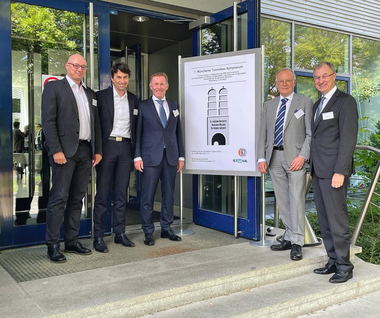
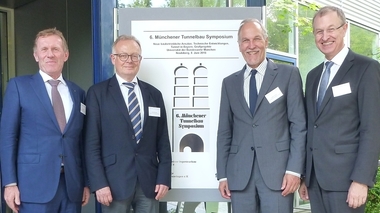
 From left: Univ.-Prof. Dr.-Ing. Conrad Boley, Univ.-Prof. Dr. techn. Philip Sander, Prof. Dr.-Ing. Roland Leucker and Univ.-Prof. Dr.-Ing. Thomas Bramel chaired the four thematic sessions at the 2026 Munich Tunnelling Symposium
Credit/Quelle: Raquel Lorente
The 9th Munich Tunnelling Symposium was organised by the Research Association for Tunnels and Transportation Facilities (STUVA) and the Supporting Association for Structural Engineering at the University of the Bundeswehr in Munich; they were supported in this by the German Federal Ministry of Transport (BMV), the Bavarian Chamber of Civil Engineers, the Bavarian State Ministry for Housing, Construction and Transport, and the construction industry.
The event took place in the university’s well-attended main lecture theatre; during the breaks between the lecture sessions, guests from Germany, Switzerland, Austria and Italy were treated to a small but select technical exhibition in the foyer.
A total of twelve specialist presentations had been curated by the programme committee for the four thematic blocks: “Tunnels in Bavaria”, “International Major Projects”, “Contract Models and Risk” and “The Future of Tunnelling”. The sessions for the individual thematic blocks were chaired by Univ.-Prof. Dr.-Ing. Thomas Bramel, Univ.-Prof. Dr.-Ing. Conrad Boley and Univ.-Prof. Dr. techn. Philip Sander from the University of the Bundeswehr in Munich, as well as Prof. Dr.-Ing. Roland Leucker, Managing Director of STUVA in Cologne.
Questions Relevant to Practical Application, Illustrated by Current Tunnel Construction Projects
 280 visitors attended the high-profile tunnelling conference in Neubiberg
Credit/Quelle: Raquel Lorente
The presentations addressed practical issues using a wide range of current tunnelling projects as examples. Naturally, one topic stood out in particular: the 2nd Munich S-Bahn main line. An engaging project presentation addressed the tunnelling challenges involved in inner-city compressed-air tunnelling using the sprayed concrete method. This method is currently employed in Munich’s soft ground to construct the connecting tunnel between the new Marienhof S-Bahn station and the existing Marienplatz underground station. Another presentation on the Haidenauplatz tunnel section of the second main line explained the application of the “Rail Partnership” model to a tunnel construction project – involving the early engagement of all project stakeholders, joint risk management and transparent open-book accounting.
The session on International Major Projects featured two very different presentations on the production of precast concrete elements for tunnel construction: starting with the production of the enormous concrete elements for the Fehmarnbelt Tunnel and continuing with automation solutions tailored to the respective conditions for the operation of concrete segment production facilities for the second tube of the Gotthard Road Tunnel.
The thematic block on the future of tunnel construction focused on three key areas: AI-supported processes, resource-efficient construction and – experience from which lessons for the future can be drawn. Prof. Konrad Bergmeister drew these lessons from insights gained from trans-European tunnel projects, which represent technical feats in infrastructure construction whilst simultaneously setting new standards for European integration, climate protection and mobility.
Next Symposium Already Confirmed
The 10th Munich Tunnelling Symposium is already confirmed and will take place in the summer of 2028.