Successful 2nd Cologne Tunnel Construction Day
On 4 March 2026, the 2nd Cologne Tunnel Construction Day took place at Cologne University of Applied Sciences. Around 160 participants attended the German-language event, which featured 11 specialist presentations offering insights into various aspects of the wide-ranging topic of tunnel construction. The lecture sessions were divided into the themes of Regional Projects, Sustainability, Planning and Construction.
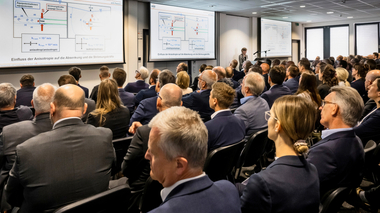
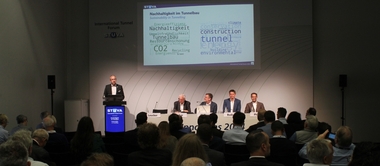
 On 4 March 2026, the 2nd Cologne Tunnel Construction Day took place at Cologne University of Applied Sciences, attended by around 160 participants
Credit/Quelle: Klostermeier
“We were delighted to have also secured exciting presentations from abroad for the conference, covering the Einstein Telescope in Belgium and the Netherlands and the Belchen Tunnel in Switzerland. We are particularly pleased that, in addition to the City of Cologne, we were able to secure the Federal Highway Research Institute and the DAUB – German Tunnelling Committee as supporting partners for the event,” said the organiser, Prof. Dr. Christoph Budach from the Department of Civil Engineering at TH Köln.
Regional Projects
In the opening presentation, Corina Atkins and Kerstin Bernards from the City of Cologne spoke about the installation of stationary sealing systems at eight existing tunnel portals to protect Cologne’s underground railway from floodwater and groundwater.
Following two floods in 1993 and 1995, a flood protection concept was developed for the City of Cologne, incorporating protective measures against flooding along the course of the Rhine. As the owner of the Cologne underground network, the City of Cologne decided to protect the facilities against flooding and commissioned a report to assess the potential impact of groundwater flooding on the Cologne underground. The objectives of the project include:
Preventing the underground network from flooding
Securing the ramps against buoyancy
Protecting the (electrical) operating equipment from damage
Maintaining train services for as long as possible during flooding
At eight existing tunnel portals, bulkhead systems must be installed to prevent the underground rail network from flooding. The construction decision for four gates has been made, with a total cost of 26 million euros; construction of the first gate is scheduled for 2026. A second contract package is planned for 2027
Other presentations in this session focused on the “Rheinspange 553 – the current status of planning for the approximately 3.0 km-long motorway tunnel” and on recent experiences from the construction phase of the new Rhine culvert in Cologne (speakers: Uwe Widerek, Christian Heinze and Janine Hofmann from StEB Cologne).
StEB Cologne is investing 110 million euros in the new Rhine culvert to create a safer and more reliable wastewater system with long-term disposal capacity. The old Rhine culvert, dating from 1928, is in urgent need of renewal and has only limited capacity.
The new Rhine culvert will consist of two pipes with diameters of 2 and 3.2 metres and will be able to transport 6000 litres of wastewater per second in future. Commissioning is scheduled for the end of 2028.
Sustainability
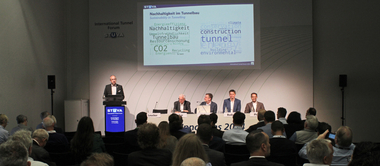
 Eleven specialist presentations covered planning, construction and research, offering insights into various aspects of the wide-ranging topic of tunnel construction
Credit/Quelle: Klostermeier
The second session addressed the topics of “CO2 reduction and resource efficiency in tunnel construction”, focusing on environmentally friendly concrete mixes and the reuse of tunnel excavation material in projects undertaken by Deutsche Bahn and DEGES (Deutsche Einheit Fernstraßenplanungs- und -bau GmbH). Here, the current circular approach to material flow management at Deutsche Bahn was explained, whereby excavated materials are no longer treated as waste – not least for economic reasons – but are instead utilised as resources.
Dr. Stefan Franz and Thorsten Kallnischkies from DEGES defined waste prevention as the primary objective for achieving a sustainable project solution, noting that the greatest leverage lies in the early planning phases. Consequently, the client also bears an ever-increasing responsibility to optimise the sustainability of a construction project.
Planning
Laurence Delplace, CEO of Amberg Engineering, gave a presentation entitled “Boundless Tunnel Construction” on the planning of the Einstein Telescope. The project involves a gravitational-wave observatory designed to study the universe through distortions in space-time. The underground location of this research facility is of central importance, as it allows for the elimination of external disturbances. The underground construction offers protection from natural seismic noise (traffic, industrial vibrations) and atmospheric fluctuations. The aim is to achieve a level of measurement sensitivity never before attained. As part of a feasibility study, important geological and hydrogeological factors are being examined to determine the site, and various suitable methods for tunnel, cavern and shaft construction are being assessed in terms of risks and costs.
Further presentations in this session dealt with the rehabilitation of the Belchen Tunnel in Switzerland and settlement predictions based on excavation classes for mechanised tunnelling in soft rock.
Construction
During the final presentation session of the Tunnel Construction Day, an overview was provided of the current progress of the renovation work on the Elleringhausen Tunnel. This railway tunnel renovation, using precast concrete elements, is a pilot project. The double-shell, open-invert precast structure is being constructed using a method based on the tunnel ring construction technique and offers an alternative to the construction of the tunnel inner shell using in-situ concrete (standard construction method). The use of precast construction for the renewal of an open-invert tunnel by DB is being employed for the first time at the Elleringhausen Tunnel.
Save the Date
The 3rd Cologne Tunnel Construction Day is already scheduled and will take place in March 2028.