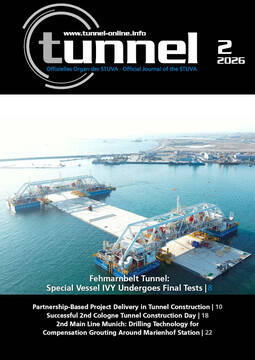
Fehmarnbelt Tunnel: Special Vessel IVY Undergoes Final Tests
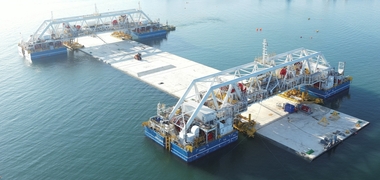
The special vessel that will be used to lower the tunnel segments for the Fehmarnbelt Tunnel is currently undergoing final tests at the working harbour near Rødbyhavn ahead of certification by the Danish Maritime Authority. To this end, the construction consortium Femern Link Contractors (FLC) connected a completed tunnel element to the immersion pontoons IVY 1 and IVY 2 for the first time in March 2026.
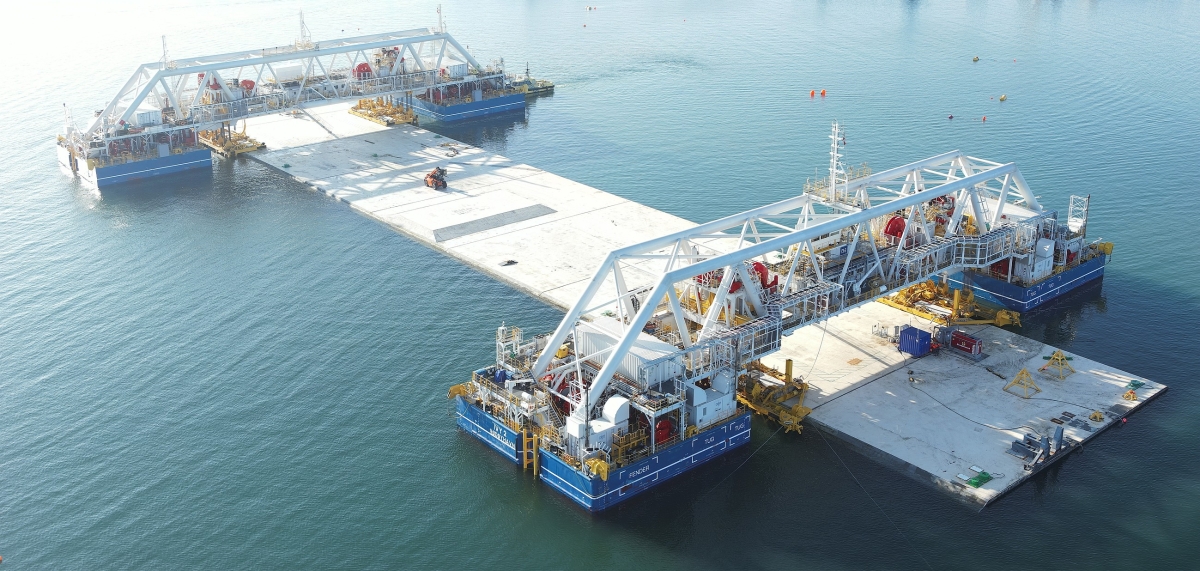 The construction consortium Femern Link Contractors connected a completed tunnel element to the immersion pontoons IVY 1 and IVY 2 for the first time in March 2026
Credit/Quelle: Femern A/S
The immersion pontoons are currently located in the large Danish work harbour on Lolland, with the first tunnel element secured between the two units. The initial phase of testing has already been successfully completed and includes, among other things, confirming that all functions operate correctly – both when IVY 1 & 2 are operated separately holding a standard element secured in between, and when they are operated as a combined vessel.
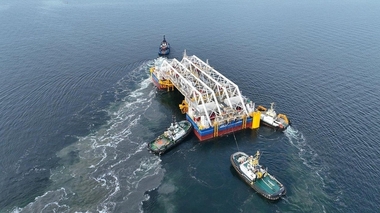
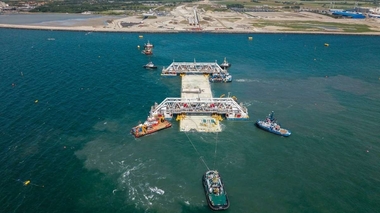
IVY will be deployed in both configurations: during transport and lowering, the 217-metre-long standard elements will be supported at each end by a pontoon. In the case of the special elements, however, IVY 1 and IVY 2 will be coupled directly together and will support these significantly shorter elements at the centre.
During the final phase of testing, additional weight will be added to the secured element, corresponding to the amount of ballast concrete required to weigh the element down. IVY will then lower and raise the element for test purposes in the work harbour.
IVY 1 and 2 Immersion Pontoons Specially Designed for Fehmarnbelt Concrete Elements
“IVY 1 and 2 is a completely unique vessel, built specifically for the tunnel elements used for the Fehmarnbelt tunnel. It has taken longer than expected to complete and test the vessel. FLC is now close to reaching the finish line, enabling the vessel to be approved to play the key role in the immersion of the tunnel’s 89 elements. We expect the first element to be immersed and connected to the tunnel portal at Rødbyhavn later this spring,” says Lasse Vester, Deputy Contract Director at Sund & Bælt.
Once the vessel has been approved by the Danish maritime authority, IVY will bring the tunnel element to the quay in the Danish work harbour, where additional concrete will be pumped inside. This will make the element heavy enough to sink to the seabed. From that moment on, it is kept afloat solely by the buoyancy of the two immersion pontoons. IVY 1 & 2 are equipped with a total of 23 kilometres of steel wire distributed across 66 winches, which are then used to immerse the element into the tunnel trench at depths of up to 40 metres, with millimetre precision.
Sund & Bælt Has Canceled Two Tenders
Construction of the Fehmarnbelt tunnel is currently delayed by around two years because of the challenges with completing the special vessel IVY. Due to the delay, the Danish state-owned company Sund & Bælt, the parent corporation of the project company Femern A/S, decided in February 2026 to cancel two ongoing tenders. The first tender concerns the Tunnel Track and Catenary (TTC) contract fo the tunnel. The second relates to a contract for new tolling facilities for both the Fehmarnbelt tunnel in Rødbyhavn and the Storebælt link at Halskov. Sund & Bælt has decided to prepare a new overall schedule for the entire Fehmarnbelt project after the first tunnel elements have been immersed. Both contracts are expected to be retendered at a later stage.