“The Gibraltar Tunnel Is Feasible”
Science meets mechanical engineering, theory meets practice, and academia meets industry. And Zurich meets Schwanau. Georgios Anagnostou and Martin Herrenknecht have a good reason to meet: A joint study by ETH Zurich and Herrenknecht AG on the feasibility of a tunnel under the Strait of Gibraltar has been finalised and concludes that this long-cherished dream is now technically feasible. A conversation among experts.
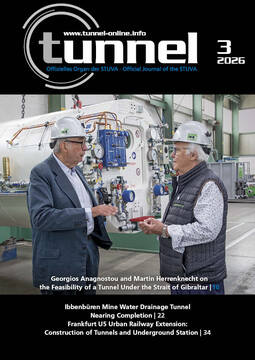
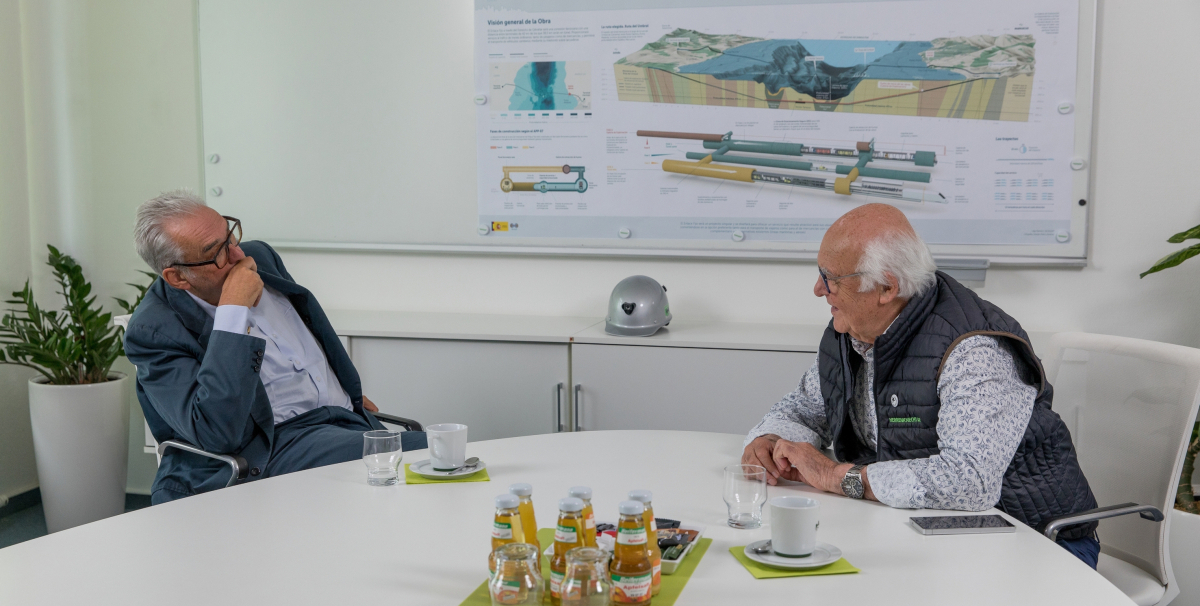 The two Muir Wood Prize winners Georgios Anagnostou (left) and Martin Herrenknecht (right) discuss the feasibility for the Gibraltar Tunnel and reflect on the project experiences and milestones that paved the way to Gibraltar
Credit/Quelle: Herrenknecht AG
The tunnel connecting Spain and Gibraltar with Morocco — and thus Europe and Africa — has been the subject of discussion and research for about 150 years. You can now jointly demonstrate with solid evidence that the exploratory tunnel for the two main tubes can now be built. Are you proud of what you have achieved together?
Anagnostou: Maybe “proud” isn’t quite the right word. But it’s very satisfying when, after grappling with a problem for so many years – one for which there was no solution for a long time – a solution now seems possible. I’d rather call it joy. And you, Mr. Herrenknecht?
Herrenknecht: I think we certainly have reason to be proud. The feasibility study is a magnificent result of the excellent collaboration between our engineers and your team at ETH Zurich. For which, by the way, I am deeply grateful to you. After all, ETH Zurich is highly regarded worldwide when it comes to research in tunnel construction.
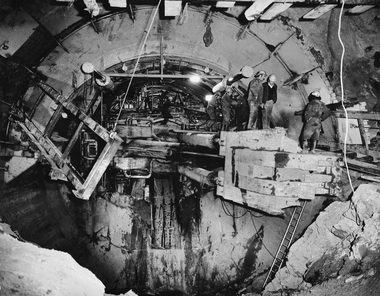
 Planning for the Gibraltar Tunnel
Credit/Quelle: SECEGSA
Anagnostou: Your geographical and cultural proximity to Switzerland is a stroke of luck for us. The gratitude is entirely on my side, Mr. Herrenknecht.
Herrenknecht: The question of whether we can build the tunnel has now been discussed for long enough.
Anagnostou: That’s right; the idea of a tunnel near Gibraltar dates back as far as the mid-19th century. That was a time of major infrastructure projects: the Suez Canal and the first major tunnels through the Alps. Even back then, the goal was to create connections, in part to develop the colonies.
A second impetus came between 1910 and 1920. Spain was seeking a new geopolitical role. It was thought that the fastest route from Europe to the Americas might run through Spain and Gibraltar, because the shortest route across the Atlantic runs from Senegal to Brazil. Today, the project is more relevant than ever – not because the idea is new, but because we now have a better understanding of the challenges and possess the necessary technology. That is precisely why we can say today: The technology is here. And the science is here.
Technology and science in tunnel construction have advanced rapidly over the past five decades. Where do we come from? Where do you come from?
Herrenknecht: When I look back 50 years, the Seelisberg Tunnel naturally comes to mind, from the early 1970s. Back then, we worked with an open-type excavator: “Big John” from the manufacturer Memco. It had 3000 metric tons of breakout force. Today, everyone would say that was the wrong machine. To be honest, we were also a bit lucky that things turned out well in the end.
The hydraulics, for example, weren’t quite there yet. We connected the tunnel segments with wooden pegs – completely crazy from today’s perspective. There was settlement because we didn’t backfill properly. When I drive through the Seelisberg Tunnel today, Mr. Anagnostou,
you know the story, I always honk my horn and pay my respects to the engineering.
And then there’s the logistics: We reworked the 2000-metric-ton machine several times, moved it, and turned it around. Today, you can only shake your head at that. Today, you’d use two machines to drive the 10 kilometers in a single stretch.
But that’s just how it was in the early days of mechanized tunnel construction. For example, there was already the Robbins machine at Heitersberg back then. Back then – just like today – it was always about learning.
Anagnostou: Until the 1960s, tunnel boring machines were used primarily in hydropower and water infrastructure projects. These were mostly small-diameter tunnels, around three meters. In Switzerland, they began very early on to employ these machines for large-diameter tunnels as well, i.e., for traffic tunnels: you mentioned Heitersberg, Bözberg, and the Kerenzerberg Tunnel. This was thanks to innovative contractors and project owners who were willing to share the risk to a certain extent and who recognized the potential of mechanized tunnelling.
Between 1970 and the late 1980s, nearly half of the world’s mechanized tunnelling projects took place in Switzerland. This allowed for practical improvements to the machines in actual use.
Herrenknecht: However, they were always well prepared. The engineers from Baumann, Murer, and Losinger traveled around the world, closely examining projects everywhere before they began planning and building themselves.
Back then, I learned from Fritz Buri, my site manager for the Huttegg construction lot in Seelisberg: If something breaks, don’t just replace it. Ask yourself why it broke. Then, if someone asks you in six weeks, you’ll be able to explain why you changed or improved something. That’s crucial. Precision and a systematic approach – these were the success factors that contributed to the progress that now makes Gibraltar feasible in our eyes.
Speaking of a “systematic approach”: What other steps were taken along the way to today’s feasibility study for Gibraltar?
Anagnostou: The project had been on hold for a long time, ever since the Spanish Civil War, and was not resumed until after the Franco era, in the 1980s and 1990s. The development of large-diameter tunnel boring machines, as mentioned earlier, played a key role, as did the experience gained from two groundbreaking undersea tunnels: the Channel Tunnel between England and France and the Seikan Tunnel in Japan, connecting the islands of Honshu and Hokkaido.
The Seikan Tunnel required overcoming extremely challenging geological conditions, including fault zones with loose material at a depth of approximately 250 meters below sea level. Earlier studies on the Gibraltar Tunnel therefore repeatedly refer to the experience gained there. Incidentally, these findings were also valuable to us in Switzerland, for example in the investigations conducted by Prof. Kovári and myself on overcoming potential fault zones in the Gotthard Base Tunnel.
The first modern Gibraltar project dates back to 1996 and was developed by the French engineering company SETEC. At that time, it was assumed that the tunnel would lie entirely within the flysch. This was plausible because the flysch formation predominates on both sides of the strait. But there had not yet been any offshore drilling. Everything was extrapolated. Today we know: It is significantly more complicated.
Herrenknecht: That said, flysch alone can be challenging due to its great variability – ranging from hard sandstones to soft claystones – and the presence of possible fault zones.
Anagnostou: Of course. But in the 1990s, engineers were confident they could use mechanized tunnelling in flysch rock for the Gibraltar project. The development of
Multi-mode TBMs also contributed to this; these machines can be used in both soft ground and rock and, depending on the need, operate with or without slurry support at the tunnel face. They opened up new possibilities for managing unstable tunnel face conditions and large water inflows. The first practical experience with this technology was gained back then, for example, in the Grauholz Tunnel near Bern.
However, the decisive change for Gibraltar came after the offshore drilling. Breccia was discovered in the middle of the strait between Spain and Morocco. This is a significantly different material: primarily soft, very weak, and clayey. And it was found at great depth, under high water pressure, and without the possibility of a mid-adit. This is a crucial difference from classical mountain tunnels. These new findings fundamentally changed the project.
Against this backdrop, the revised 2007 project was developed under the direction of Dr. Lombardi. He thoroughly examined the risk of shield jamming and concluded that three main factors needed to be considered: To avoid shield jamming, space must be created using a large overcut. The tunnel face must be securely supported, using a Slurry Shield or Earth Pressure Balance Shield. And finally, the ground must be consolidated through advance drainage. However, Dr. Lombardi considered a final feasibility assessment possible only on the basis of further investigations.
Research conducted at ETH Zurich showed that the situation was more complex than previously thought.
Anagnostou: We examined the mechanical and hydraulic properties of the breccia in the laboratory. The results were initially sobering. The water permeability turned out to be about a hundred times lower than previously assumed. As a result, the ground consolidation through drainage – which was considered essential – would have taken so long that the construction of the tunnel seemed practically unfeasible.
 Lötschberg Base Tunnel, Switzerland
Credit/Quelle: Herrenknecht AG
 Eurasia Road Tunnel, Istanbul, Türkye
Credit/Quelle: Herrenknecht AG
Nevertheless, they didn‘t give up. For several years now, Herrenknecht AG has been working with ETH Zurich to study the feasibility of the project. What was the background to this?
Anagnostou: We are doing this on behalf of the participating state-owned companies. This initiative was triggered by advances in science and mechanical engineering. The scientific advances included new findings on mechanized tunnelling and tunnel-face behavior under highly squeezing conditions. The technical advances, in turn, resulted from experience gained in other extreme tunnelling projects.
Herrenknecht: Lötschberg, Gotthard, Hallandsås, Lake Mead, Bosporus – these were tunnelling projects from which we learned a great deal. Before we could tackle the Gotthard, we first developed the machines for Tscharner and then for Lötschberg. Open-type gripper machines, single gripper system, without a shield, and with a flat cutterhead. Prof. Kovári warned us that if we came to Switzerland with complicated shield machines, he would send us straight to the Lucerne Transport Museum with them.
Anagnostou: As you can see, that didn‘t happen – today, the cutterhead of a Gripper TBM from the Gotthard project stands there.
Hallandsås, the twin-tube railway tunnel in Sweden, is frequently cited as one of the landmark examples of progress in mechanical engineering and the wealth of experience in tunnel construction.
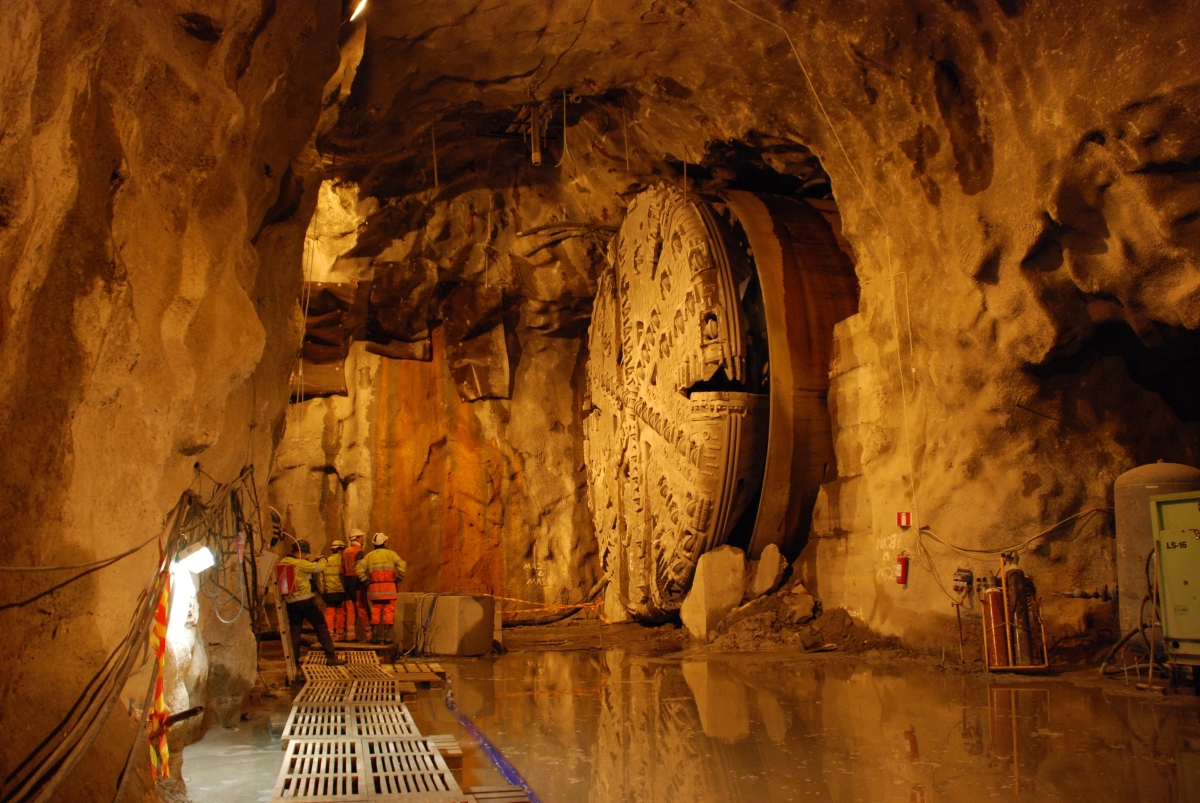 For several years now, Herrenknecht AG has been working with ETH Zurich to investigate the feasibility of a tunnel beneath the Strait of Gibraltar. This was prompted by advances in science and mechanical engineering. These technical advances stemmed from experience gained in other extreme tunnelling projects, such as the Hallandsås Tunnel in Sweden (Photo)
Credit/Quelle: Herrenknecht AG
Herrenknecht: When our machine arrived at the construction site, it was already the third attempt to build the tunnel. All previous attempts had failed. The water pressure was extreme by the standards of the time; we had to design the machine to withstand 13 bar. And in some sections, the rock was very rugged and blocky. The amount of water we were allowed to remove from the tunnel was strictly limited by law, which meant constant grouting operations. All in all, this was only possible with a convertible Multi-mode TBM
capable of handling both the rock and the high water pressures. And with crews on the construction site who, for eight years, never considered giving up – instead, for example, installed a new cutterhead right in the middle of the mountain. An incredible achievement that I still have the utmost respect for.
Anagnostou: I am not familiar with the project firsthand, but I know it well from the technical literature. Hallandsås is a prime example of the importance of close collaboration between the contractor and the machine manufacturer during construction – not only to overcome the project-specific challenges, but also to further develop the technology.
 Lake Mead Intake No. 3, Nevada, USA
Credit/Quelle: Herrenknecht AG
I, on the other hand, am very familiar with the next milestone after Hallandsås from my own experience: Lake Mead in the U.S. Here, the Multi-mode TBM had to be designed to operate at 17 bar. Our group at ETH Zurich focused primarily on determining whether and for how long the tunnel face would remain stable, under what conditions the TBM could be operated in open mode, and how entries by divers into the working chamber could be avoided or minimized as much as possible. In the Lake Mead project, the machine was operated in closed mode over long sections of the tunnel and run at a slurry pressure of up to 15 bar. This provided us with the know-how and practical experience to conclude that even the Gibraltar project, at 20 bar, is feasible and does not require a fundamental technological leap.
Herrenknecht: That reminds me of another saying I’ve heard in Switzerland: You always have to build a tunnel three times – twice in theory and only then in practice.
It’s always difficult to venture into uncharted territory. And there will always be surprises. It is always dark ahead of the cutterhead. But with this approach, you’re simply better prepared – especially when it comes to ensuring the safety of the staff.
I’m convinced we’ve now thoroughly covered the theory for Gibraltar. So now we can actually start building.
But what exactly is the plan for Gibraltar? How do they intend to pull it off?
Anagnostou: As mentioned, drawing on the experience and technical and scientific advances of the past decades. Earlier considerations were based on the premise that, due to the risk of shield jamming, any contact between the shield and the ground – and any resulting ground pressure – should be avoided entirely. This was to be countered by a large overcut – 40 cm – as well as ground improvement through drainage. These are measures that we now consider neither feasible nor necessary. Today, we can estimate ground pressure more reliably.
Furthermore, we know that we can design a shield to withstand the expected pressure and equip a machine with sufficiently high thrust forces. We have examined the corresponding requirements for the machine and their implementation with Werner Burger, Head of Engineering at Herrenknecht. We expect to be able to install a thrust force of just over 300 meganewtons, which will also provide us with good protection against jamming. Another issue that was examined in depth concerned the behavior of the tunnel face. We expect very large axial deformations of the ground in front of the cutterhead. These must be taken into account during the excavation process and can lead to an additional excavation volume of 30–40%. However, with a support pressure of 20 bar, the additional excavation volume is significantly reduced and the stability of the tunnel face is increased.
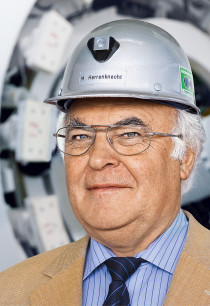
 Martin Herrenknecht: “I hope that we can inspire future generations to take an interest in tunnel construction and pass on our
fascination to young men and women. The challenges aren’t getting any smaller”
Credit/Quelle: Herrenknecht AG
Herrenknecht: The 20 bar, as I said, remains a challenge, but one we can handle after Hallandsås and Lake Mead. However, there are still many other issues that we had to rethink for the feasibility study. For example: How do we configure sufficiently powerful pumps for the slurry circuit for such a long and deep tunnel drive? Or: How do we design a tunnel boring machine that can safely handle the extremely heavy tunnel segments? I see a challenge for the tunnel’s construction in the fact that we cannot afford to have the machine experience any extremely long downtime, even though the planned measures are sufficient to cover downtime lasting several months. So everyone involved needs to be in it for the long haul. The entire logistics operation must be on point. And the financing must be solid in the long term.
Which brings us to the question: Is the tunnel under the Strait of Gibraltar not only technically feasible, but also economically viable?
Anagnostou: How much should a resilient and robust infrastructure cost? In the long term, the question is not so much whether a fixed link would be used for freight and passenger transport, but rather what strategic value it would have for Europe and Africa. It is clear that a fixed link could offer enormous benefits, for example for intercontinental energy networks. The potential is enormous.
Herrenknecht: I agree. After all, the world is full of examples right now where our existing trade and transportation routes are coming under pressure and where we are desperately searching for alternative routes.
When we looked back at the past 50 years of tunnel construction at the beginning—how do you, with your decades of experience, look toward the future?
 Georgios Anagnostou: “I remain extremely interested in the interplay between project requirements and technical solutions”
Credit/Quelle: Herrenknecht AG
Anagnostou: I remain extremely interested in the interplay between project requirements and technical solutions. Multi-mode machines, for example, will continue to evolve, thereby constantly pushing the boundaries of what is possible.
Herrenknecht: I hope that we can inspire future generations to take an interest in tunnel construction and pass on our fascination to young men and women. The challenges aren’t getting any smaller—quite the opposite—but the opportunities to make a positive difference in the world are immense. Start your training now with the goal of one day being part of the Gibraltar Tunnel project!