BASt Research Project “EINFACH” Launched
In January 2026, the new collaborative research project EINFACH (German acronym for „Single-shell tunnel construction using CO2-optimised fibre-reinforced sprayed concretes – rethinking tunnel shells sustainably!“) was launched. For the next two years, STUVA, as coordinator, along with the research partners BUNG-PEB Tunnelbau-Ingenieure GmbH, KIT – IMB/MPA Karlsruhe, and Ed. Züblin AG, as well as the associated partners “Die Autobahn GmbH des Bundes” and “DEGES – Deutsche Einheit Fernstraßenplanungs- und -bau GmbH,” have set their sights on ambitious goals.
 Together for a better environmental footprint in tunnel construction: the “EINFACH” team at the kick-off event at STUVA on 11 February 2026
Credit/Quelle: STUVA
The “EINFACH” research project, commissioned by the Federal Highway and Transport Research Institute BASt, aims to further develop traditional traffic tunnel construction in Germany with a focus on sustainability and to investigate an innovative, resource-efficient, and economically competitive mined tunnel construction method that has the potential to be put into practice in the future.
So far, road tunnels in Germany are typically constructed as a double-shell system comprising a temporary outer lining made of reinforced sprayed concrete and an inner lining of in-situ reinforced concrete. Sealing is usually provided either by a continuous plastic waterproofing membrane or by designing the structure as water-retaining concrete (WU structure). While this construction method is fundamentally robust, it unfortunately has serious disadvantages: above all, the high consumption of raw materials and the poor CO2 footprint make a significantly leaner construction method necessary against the backdrop of current climate protection goals. This is precisely what “EINFACH” aims to achieve.
CO2 -Optimised Sprayed Concrete Mix
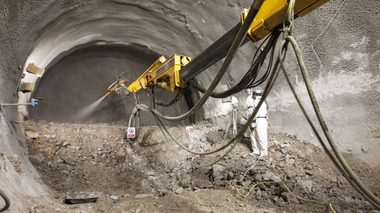
 Tunnel construction with sprayed concrete
Credit/Quelle: Strabag SE
The first step is to develop a CO2-optimised sprayed concrete mix that combines clinker-reduced cements with suitable mineral additives. This sprayed concrete is intended to contain both steel fibres and polypropylene fibres to ensure load-bearing capacity and fire resistance.
A key challenge is ensuring sprayability, as steel fibre concretes – especially when polypropylene fibres are added – exhibit increased stiffness at the same w/c ratio. Rheology, layer stability and early strength therefore need to be optimised in laboratory tests to guarantee reliable application.
Single-Shell Sprayed Concrete Tunnel Lining
The project partners also aim to demonstrate in large-scale trials that a single-shell lining constructed from this sprayed concrete can achieve the water tightness required for a WU structure without the need for an additional waterproofing membrane.
The main objective of “EINFACH” is to demonstrate clear ecological and economic advantages of the single-shell fibre-reinforced sprayed concrete lining compared with conventional double-shell linings. To this end, a life cycle assessment (LCA) is being carried out, recording in particular the greenhouse gas emissions (GWP) and material flows throughout the entire life cycle.
The findings from the project are intended to help lay the groundwork for the potential future application of this construction method in tunnelling and to identify opportunities for further improving existing regulations.
“EINFACH” (FE No. 88.0241/2025/AV01) is funded under the “Innovationsprogramm Straße” support scheme by the Federal Highway Research Institute (BASt) on behalf of the German Federal Ministry of Transport.