Partnership-Based Project Delivery in Tunnel Construction
Conventional project delivery models with unit or lump sum remuneration regularly reach their limits, especially in large-scale projects. There are many reasons for this. Integrated Project Delivery (IPD) offers a practical, cooperative approach here. Particularly for tunnel construction, with its geological uncertainties, long tunnel drives and safety-critical conditions, partnership-based project management can improve cost and schedule reliability and avoid claims and interface conflicts. At the same time, a solution-oriented project culture is promoted through the timely involvement of all parties. This article marks the start of a series of publications on IPD and presents the basic principles of IPD and current IPD tunnel construction projects in Austria and Germany.
1 Motivation and Background
Large and complex infrastructure projects, especially tunnel construction projects, repeatedly reveal the limitations of conventional project delivery models. The provision of services via traditional bill of quantities in combination with a strongly price-oriented tendering process encourages conflicts, claims and inefficient processes. Operational challenges and the joint achievement of objectives often take a back seat. However, complex risk profiles, long project durations and a high degree of uncertainty in cost and schedule forecasts actually require flexible and cooperative approaches [1].
Innovative project delivery models with a partnership-based approach, such as Integrated Project Delivery (IPD), address these issues and offer a practical approach to successful project implementation. IDP and other models such as Collaborative Project Delivery (CPD) have their roots in the Anglo-American sphere [2].
The design of a partnership-based project delivery model can take various forms and bear different names. In Austria, for example, the term “alliance model” is used, Deutsche Bahn uses the “PM Railway” and Amprion GmbH has developed the “Progressive Partnering Contract
Civil Engineering” (PPT) for its major projects. In Bavaria, the newly developed IPD compact model is used. However, all models are based on the same basic principles [3].
In Germany and Austria, numerous infrastructure projects are currently being delivered using the principles of IPD. This cooperation model is also becoming increasingly important in tunnel construction. Completed tunnel projects in Austria already provide valuable experience, from which fundamental insights and lessons can be drawn.
The aim of this series of publications on IPD is to systematically process and disseminate the insights gained. In addition, selected IPD projects will be presented and different types of Integrated Project Delivery models will be analysed. This article focuses on the basic principles of IPD and provides an overview of current tunnel construction projects in which IPD models are being used.
IPD Innovation Hub
The IPD Innovation Hub (www.ipd-hub.de), a centre of excellence for collaborative construction project management, was established at the University of the Bundeswehr Munich to systematically process and share project experiences, best practices and lessons learned. The IPD Hub serves as a central research and exchange platform for recording, analysing and disseminating experiences from projects involving partnership-based project management. To date, findings from more than twenty national and international projects with different types of partnership-based contract and organisational models have been systematically evaluated there.
The IPD Innovation Hub sees itself as an open and interdisciplinary platform for all players in the construction industry – from public and private clients to planners and construction companies to scientific institutions. It was initiated as part of the dtec.bw research project DigiPeC, which is funded by NextGenerationEU, and receives support from the Bavarian Construction Industry Association, the Bundeswehr and funding programmes such as Zukunft Bau.
The aim of the IPD Innovation Hub is to strengthen the transfer of knowledge between science and practice, promote interdisciplinary exchange and thus contribute to the sustainable establishment of partnership-based project delivery models in the construction industry [4].
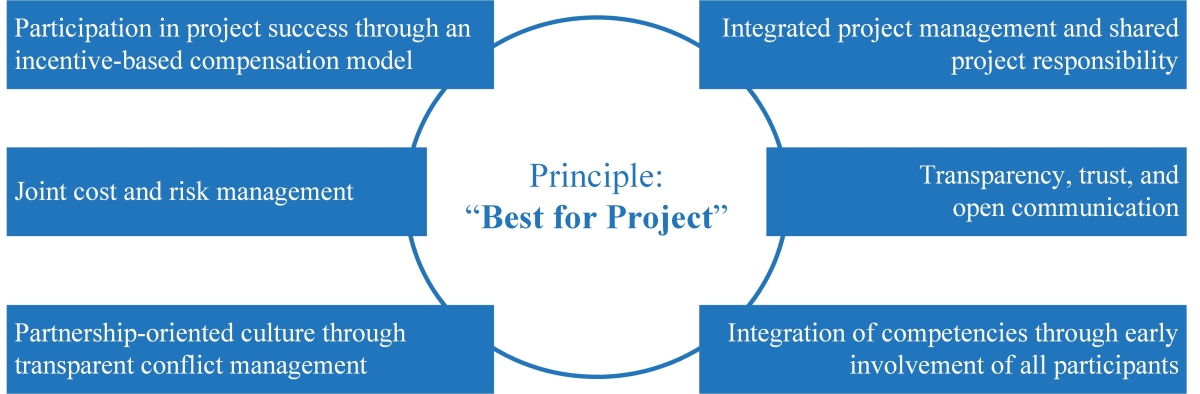 1 | Basic principles of Integrated Project Delivery [5]
Credit/Quelle: Sander, Friedinger, Stangl, Spiegl
2 Basic Principles of IPD
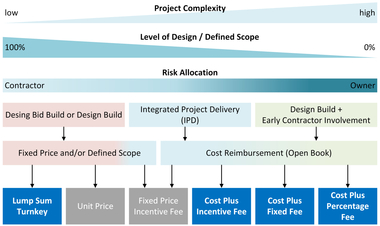
The basic principles of IPD are shown in Figure 1 and explained in more detail in this chapter. They form the foundation for the development of partnership-based project delivery models. Depending on the size of the project, its objectives and the external conditions, these models can vary, but they always follow the guiding principle of “best for project” – i.e. the primacy of project success over individual interests. This idea shapes the decisions, processes and behaviour of those involved. The aim is cooperative, transparent and results-oriented collaboration that promotes cost-effectiveness, quality and adherence to deadlines in equal measure. When initiating IPD projects, great importance must be attached to the development of a project-specific delivery model. The Progressive Partnership Framework (PPF) was developed for this purpose and is described in one of the following articles [5].
Participation in project success through an incentive-based compensation model
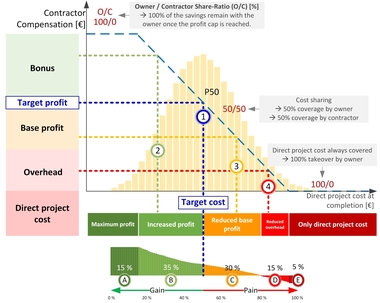
The economic interests of the client and contractor are aligned through shared target costs, open calculations and billing (open book principle) and bonus-malus regulations. This system promotes a shared interest in efficiency and project success. In addition, there is a strong incentive to develop economic solutions that benefit the overall project, as all parties involved are directly involved in the success of the project.
Joint cost and risk management
Risks (dangers and opportunities) are identified, assessed and managed jointly. Instead of unilateral risk transfer, the focus is on cooperative management. Probabilistic simulations form the basis for a realistic target cost. Especially in tunnel construction, where geological uncertainties and ground risks can have a significant impact, this principle is central to cost and schedule reliability.
Partnership-oriented culture through transparent conflict management
Conflicts are identified at an early stage and resolved jointly. The focus is on solution-oriented communication and a spirit of partnership throughout all project phases, with the aim of reducing conflicts and strengthening trust among project participants.
Integrated project management and shared project responsibility
All project participants make decisions together and take responsibility for the project results. Integrative control structures reduce interfaces and improve overall coordination. Especially in complex construction processes, e.g. in tunnel construction, this joint control leads to greater planning reliability and project quality.
Transparency, trust and open communication
An open exchange of information and complete cost transparency create trust, a uniform understanding of the project and ensure objective decision-making. This strengthens team work and enables joint action, even in critical phases of the project.
Integration of competencies through early involvement of all participants
The early involvement of all key players, such as planners, construction companies and operators, enables the optimal use of technical and economic expertise. This helps to avoid planning errors, optimise construction processes and reduce interface risks.
Advantages of the IPD
International experience and completed IPD projects and alliance projects in Austria show that partnership-based project management contributes significantly to project success. The following positive effects can be observed:
High cost and schedule reliability
Reduced project risk through joint and holistic risk management
Less contractual disputes through transparent decision-making processes
Increased innovation and sustainability through early cooperation
Improved execution quality
Stronger team culture with constructive conflict resolution
3 Overview of Tunnel Construction Projects
 2 | IPD infrastructure projects in Germany and Austria, tunnel projects highlighted in orange (updated from [2])
Credit/Quelle: Sander, Friedinger, Stangl, Spiegl
 3 | Angath shell tunnel
Credit/Quelle: ÖBB Infrastruktur AG; [6]
 4 | Tisis rescue tunnel
Credit/Quelle: Land Vorarlberg; [6]
The map in Figure 2 shows an overview of infrastructure projects (blue lines and blue and orange dots) in Germany and Austria that have integrated the basic principles of IPD into their project delivery models. The projects shown on the map (tunnel construction projects, power plants, bridges, cable routes) use different partnership-based project delivery models. These include alliance contracts (particularly common in Austria), the rail partnership model (DB) and the “Progressive Partnering Contract Civil Engineering” (PPT, Amprion GmbH). The tunnel projects are highlighted with orange dots.
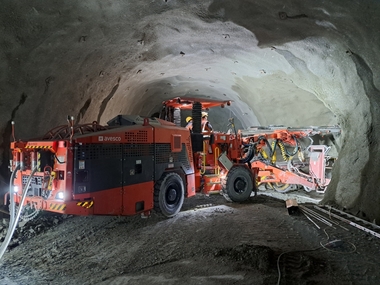
As presented at the 8th International BBB Congress (2025) in Vienna, there are now several projects in Austria that have been successfully implemented using alliance models. Examples from the field of tunnel construction include the Angath structural tunnel as part of the Brenner North Access construction project (Fig. 3) and the Tisis exploratory and rescue tunnel (Fig. 4) of the Feldkirch city tunnel. The Schmittentunnel rescue tunnel (Land Salzburg) was implemented using a “light” alliance model. Other projects using the alliance model that are in the planning or execution phase include the Landeck Tunnel on the A12 motorway, the renovations of the Tauern and Katschberg tunnels on the A10 motorway [6], the renovation of the Reutte power plant, the second stage of the modernisation of the Tauern Tunnel and the second part of the escape and rescue tunnel at the Schmitten Tunnel.
In addition, major tunnel construction projects in Germany are also in the planning or implementation phase, in which various IPA models are being used, including Lot VE734 of the 2nd Munich S-Bahn Main Line (DB InfraGo AG; Fig. 5), the Gäubahn Nord – Pfaffensteig Tunnel expansion (DB InfraGo AG), the Rhine crossing of the A-Nord power line (Amprion GmbH), the Fehmarn Sound crossing (DB InfraGo AG; Fig. 6) and the Elbe crossing of the power line Corridor B (Amprion GmbH; Fig. 7).
 5 | Lot VE734 of the 2nd Munich S-Bahn Main Line
Credit/Quelle: DB InfraGo AG
 6 | Fehmarn Sound crossing
Credit/Quelle: DB InfraGo AG
 7 | Elbe crossing
Credit/Quelle: Amprion GmbH
The effectiveness of such models is demonstrated by the first Austrian tunnel construction project with an alliance contract – the Gemeinschaftkraftwerk Inn (GKI). A study by the University of the Bundeswehr Munich (UniBw M)
compared the tunnelling advance rate under alliance contract with that under unit price contracts. The results confirmed a reduction in construction time thanks to cooperative and proactive risk management in the alliance contract [7].
The growing use of IPD models across infrastructure sectors shows that cooperative approaches are becoming effective tools for delivering complex projects.
4 Outlook
In upcoming articles, selected projects and experiences with the application of IPD will be reported. The focus will be on the selected project delivery models, the key success factors and the transferable insights for future projects.
The following article presents the initiation process of a partnership-based project delivery model based on the Progressive Partnership Framework - from initial preparation through the step-by-step development of the model to its contractual design.