Process Simulation as a Planning Tool: Logistics Optimisation for the Fürth Freight Train Tunnel
The implementation of large-scale projects requires robust planning that takes into account various target variables such as sustainability, construction time and cost. In recent years, the demands on planning and execution have increased due to greater emphasis on the interests of public authorities (noise, dust and traffic emissions) and new legal regulations (German Substitute Building Materials Ordinance ‘ErsatzbaustoffV’). Process simulation is a suitable method for designing the construction process as efficiently and robustly as possible in the early stages of planning and for holistically assessing the impact of changes in the planning process on execution. Using the Fürth Freight Train Tunnel project as an example, this article shows how simulation-based planning methods can help to transparently present and analyse interfaces in logistics planning, realistically model construction processes and thus support informed decisions.
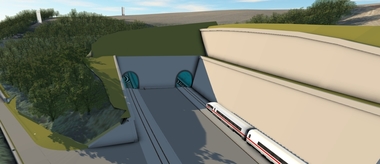
 1 | For the Fürth Freight Train Tunnel infrastructure project, simulation-based planning methods are being applied
Credit/Quelle: DB InfraGO
1 Introduction
As part of the large-scale VDE 8.1 Nuremberg–Ebensfeld project, DB InfraGO is commissioned by the German government to expand and construct a high-performance railway line between Nuremberg and Erfurt. One sub-project is the construction of the new double-track freight line 5955 from Nuremberg-Kleinreuth to Erlangen-Eltersdorf, which is intended to relieve the heavily frequented main station in Fürth (Bay) of freight traffic and thus create additional capacity for passenger transport. A central structure of the section is the Fürth Freight Train Tunnel, which is to be constructed as a single-tube, double-track tunnel using both mechanical and open construction methods. The section of the tunnel to be constructed using mechanised tunnelling is approximately 6.5 km long and has an excavation diameter of around 13.0 m.
In view of the complexity of the project and the logistical requirements of mechanised tunnel boring in the catchment area of the city of Nuremberg, with few directly adjacent landfill or processing sites for spoil, it was decided at an early stage to support the planning with a simulation-based logistics study.
The aim was to identify potential for optimisation in logistics planning at an early stage and to increase the robustness of the construction process. Not only were the TBM driving processes modelled and examined, but all processes for supplying the TBM and logistics processes on the construction site, such as the supply and disposal logistics for spoil and segments, were also analysed. Technical malfunctions as well as scheduling and logistical restrictions of relevant entities (TBM, separation, multi-service vehicle, crane) were also taken into account.
2 Project Presentation: Fürth Freight Train Tunnel
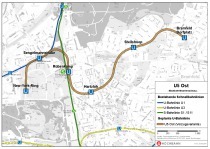
The section between Nuremberg and Fürth is one of the busiest in Bavaria, as it handles a large proportion of local and long-distance traffic from the west (Würzburg) and north (Bamberg). The construction of the new 15 km double-track freight line will provide lasting relief for the railway junction around the city of Fürth. The central structure is the 7.5 km long freight train tunnel (Fig. 1).
As part of the expansion of the Fürth junction station, a new freight train line is to be built from Nuremberg to Eltersdorf. The freight train line from Nuremberg marshalling yard to Eltersdorf is around 15 km long. It begins with the four-track expansion of the existing double-track line Hohe Marter–Fürth freight station (5950) and descends into a single-tube, double-track tunnel at Nuremberg Großmarkt station. The 7.5 km long tunnel passes under districts of Nuremberg and runs under the A73 motorway in the Fürth urban area. From the end of the tunnel in Fürth-Kronach, the line runs closely alongside the existing A73 motorway and joins the existing track system at Eltersdorf station.
The entrance to the tunnel structure is from the south via a 710 m long ramp trough, which is followed by an cut-and-cover tunnel section with a length of 505 m. The TBM-driven tunnel section is being excavated from north to south using a Variable-Density Tunnel Boring Machine (VD-TBM). This type of TBM allows the operating mode to be adapted to the prevailing geology. The spoil can be removed either by hydraulic conveyance with downstream separation (fluid-supported operating mode) or by conveyor belt (EPB operating mode). In the Pegnitz area, the freight train tunnel reaches its deepest point around 30 m below the surface. In the northern section of the project, the freight train tunnel also leads to the surface via a 435-m-long cut-and-cover section and a 420-m-long trough structure. Seven emergency exits consisting of shaft structures and adits will be built along the freight train tunnel.
Six railway overpasses and one road overpass will be newly constructed along the above-ground section of the freight train line. In addition, two existing road overpasses will be adapted to the new line.
The project covers three planning approval sections. Planning approval section 13 (PFA 13) covers the southern section of the line and the adjacent tunnel structure. Building permission has been granted for this section. The open section aligned with the A73 motorway is part of PFA 16. This section is currently undergoing the approval process. The connection of the freight train line to the Eltersdorf junction is part of PFA 17, which has already been partially implemented on the basis of the existing building permission.
In the course of planning the freight train line, a number of optimisation potentials have been examined and implemented. With the conversion of the tunnelling technology to Variable-Density TBM, around 3 km of the tunnel can be excavated without the addition of support fluid. This improves the recyclability of the tunnel excavation material. In this context, the base filling of the tunnel tube with in-situ concrete was also re-evaluated. The tunnel carriageway and shoulder will continue to be founded on a base slab, with the remaining cavity being filled with a gravel-sand mixture. All in all, optimisations in the planning stage have already made it possible to sustainably reduce construction site traffic and CO2 emissions, among other things.
The ongoing optimisation of construction site logistics for supply and disposal in the context of mechanised tunnel boring to reduce disruption and environmental impact while ensuring smooth construction progress is being continued with a simulation-based approach. The use of process simulation for the project allows various planning parameters to be reviewed and their impact on the construction of the freight train line to be assessed.
3 Process Simulation
3.1 Background and Methodology
Process simulation models are virtual representations of a real system. They make it possible to analyse, optimise and transparently present complex processes and their temporal, spatial and resource-related dependencies before they are implemented. Particular focus is placed on understanding and taking into account process dependencies and interactions. The overall process is broken down into individual sub-processes, such as the arrival of a transport vehicle, the start of a tunnelling cycle or the unloading of material at an intermediate storage facility. Each event changes the state of the system and affects subsequent processes.
While process simulations have been established in the industrial sector for many years, their use in construction has only gained importance in recent years. Examples of applications in tunnel construction include simulation-based performance forecasts [1; 2], simulation-supported optimisation of construction site designs [3; 4] and analyses of supply logistics [5]. The use of process simulation models in mechanical tunnel construction has been investigated in depth scientifically, for example in the Collaborative Research Centre 837 ‘Interaction Models for Mechanised Tunnel Construction’ at the Ruhr University Bochum [6].
The creation of simulation models is described in VDI Guideline 3633 Sheet 1 [7], which specifies a structured procedure from target definition and model creation to result analysis and accompanying verification and validation. The level of abstraction and detail of the simulation is always tailored to the objective. Depending on the issue at hand and the availability of data, the simulation model can also be constructed either deterministically or stochastically. Stochastic models enable the modelling of uncertainties and random fluctuations within the processes, thus allowing for a more realistic simulation of complex construction and logistics processes. Typical examples of use are the modelling of technical failures, varying delivery times, congestion or waiting times in construction site traffic, and uncertainties in geotechnical parameters. By taking such uncertainties into account, risks can be identified at an early stage and the robustness of planning decisions can be improved.
3.2 Potential Applications
 2 | Potential applications for the use of process simulation in various project phases
Credit/Quelle: BUNG-PEB
The process simulation methodology is not limited to any particular service phase or specific construction method. Rather, it offers application potential across all project phases – from early planning and approval and tendering procedures to execution and project management (Fig. 2).
Even in the preliminary and draft planning stages, simulation supports the systematic evaluation of alternative planning concepts, taking into account logistics, construction time and use of resources. In the approval phase, it can contribute to the assessment of environmentally relevant impacts – such as traffic congestion or noise emissions – and thus increase the transparency of the planning for third parties. Simulation results can also be used to define performance indicators and target specifications in the tendering process.
During construction, process simulation supports dynamic project management and the early identification of bottlenecks or target deviations. In addendum management, it can also be used for the objective evaluation of disrupted construction processes. In particular, it offers the possibility of comparing actual processes with simulated target processes, thereby providing a clear picture of the causes of delays.
4 Simulation Study and Evaluation
For the logistics study on the Fürth Freight Train Tunnel, BUNG-PEB developed a highly adaptable process simulation model in the Python-based simulation environment Salabim [8], which can be used to simulate the construction process and logistics of EPB, slurry or VDS TBMs. The model simulates tunnel driving with its geological constraints, the transport processes for segments and spoil material, and time restrictions on transport processes (night-time driving restrictions, Sundays and public holidays). In the spoil transport process, the storage times of the spoil material for sampling in accordance with the German Substitute Building Materials Ordinance are taken into account and the route taken by the trucks between the landfill site and the external segment storage facility is included in the simulation.
4.1 Model Presentation and Model Limitations
The simulation study carried out is based on the existing planning, forecasts from the geotechnical/tunnel construction assessment, the separation concept, the logistics concept and its interpretations (including geotechnical parameters, laboratory tests and construction recommendations). A stochastic simulation model was developed in which the process durations and performance estimates are represented by suitable distribution functions based on empirical values, expert estimates and supplementary literature values. The estimated tunnelling performance of the TBM varies depending on the predicted geology. In addition, a learning curve for the miners during ring construction is represented.
Mechanised tunnel driving was implemented by modelling various entities using a discrete event-oriented modelling approach (DES). Various entities such as the TBM, separation, multi-service vehicles and the crane were modelled including technical malfunctions. The duration and frequency of malfunctions were defined by the time between failures (TBF) and repair times (TTR). Once the operating time has elapsed, the process stops for the duration of the repair time before continuing.
 3 | Layout of the construction site for the mechanised tunnel drive north of Fürth-Kronach
Credit/Quelle: BUNG-PEB
 4 | Dashboard visualisation of the construction process
Credit/Quelle: BUNG-PEB
The TBM can change the excavation mode according to the Variable Density Technique. Therefore, hydraulic conveyance with subsequent downstream separation and the removal of spoil by conveyor belt have been implemented in the simulation model. The temporary storage areas for segments and spoil material on the construction site were taken into account in the
simulation model in accordance with the previous planning. For spoil transport, storage times of 16 days were planned, during which the spoil must be sampled and analysed in accordance with the Substitute Building Materials Ordinance (ErsatzbaustoffV). Separate piles with a total volume of over 40 000 m3 are therefore planned for single-type interim storage (Fig. 3). In addition, time restrictions such as night-time driving bans and driving prohibitions on Sundays and public holidays in the state of Bavaria were integrated into the simulation.
A 2D animation of the tunnelling process was developed to simplify visualisation (Fig. 4). The animation allows the simulation runs to be traced and the plausibility of the simulated construction process to be verified.
4.2 Simulation Study Procedure
The analysis and optimisation of the mechanised tunnel driving was carried out in several stages. In the first stage, only the processes on the construction site were considered for the analysis and subsequent verification of the construction schedule. The model boundaries included the delivery of segments and the removal of spoil from the construction site, but did not take into account the external truck routes. Monte Carlo simulation studies (numerical calculation algorithm in which repeated random samples are used to evaluate the probability of occurrence of results) were carried out for the analysis and statistically evaluated. The assumptions from the current status of the design planning were selected as input parameters.
In the second stage, variant studies were carried out on construction logistics roads in connection with the higher-level road network.
4.3 Stage 1 of the Simulation Study (Intra-Logistics of the Construction Site)
In the first step, the current status of the design planning was simulated. The most important findings of the design planning analysis are summarised below.
 5 | Average time distribution of the critical path
Credit/Quelle: BUNG-PEB
 6 | Condition of the heaps over the construction
period for a simulation run
Credit/Quelle: BUNG-PEB
 7 | Dependence of average advancement performance on the number of wheel loaders in operation
Credit/Quelle: BUNG-PEB
 8 | Influence of the storage time for sampling spoil on the average tunnelling performance
Credit/Quelle: BUNG-PEB
Figure 5 shows the average time required for the processes on the critical path of tunnel driving, based on 300 simulation runs. The average daily tunnelling performance is approximately 9.5 m. On average, over 40% of the construction time is accounted for by unplanned downtime, mainly due to overfilled spoil heaps on the surface area. The tunnelling performance assumed in the design was confirmed overall.
In the next step, a bottleneck analysis was carried out to identify the causes of the delays in spoil logistics. Although according to the traffic study, up to 370 truck trips per day would be possible, only 185 transports were realised on average. The analysis shows that spoil was continuously available for removal throughout the entire construction period (see green curve in Fig. 6).
This study suggests that the bottleneck in the construction process is not due to the required storage time for the material or the available daily truck transports for spoil removal. The critical point in the simulated TBM tunnelling lies in the loading process of the trucks on the construction site, for which two wheel loaders were originally planned.
Figure 7 illustrates the dependence of the average advance rate on the number of wheel loaders used: by using four wheel loaders instead of two, the average daily advance rate can be increased by about two ring lengths – with the same maximum number of trucks. If a further increase in advance rate is desired, the daily number of possible truck transports must also be increased.
The required duration of the storage time for the spoil material had not yet been finally clarified at the time of the simulation study. The storage time is generally subject to uncertainty, as it depends heavily on the availability of the geotechnical/environmental laboratories that will be sampling the material. Therefore, the effects of shortening or extending the storage time on the average advance rate and construction time were also investigated. The storage time was varied from a minimum of one day to a maximum of 21 days (Fig. 8). The study was carried out with two and four wheel loaders for loading spoil. For four wheel loaders, no effect on the storage time can be observed up to a calculated value of 13.2 days. However, if the storage time is increased further, the average advance rate decreases rapidly. When considering two wheel loaders, no significant influence of the required storage duration on the average advance rate is apparent, as the bottleneck in the construction process is the loading process for spoil.
The duration of a change in tunnelling mode for a Variable Density TBM can be eight to twelve shifts, depending on the selected machine configuration. The effects of an additional mode change when passing under a fictitious point of constraint on the average tunnelling performance were investigated. Two TBM conversions were planned, each with a conservative duration of six days (twelve shifts). The simulation results show that, under the same boundary conditions as those selected in the design planning, there is no significant change in the construction time. The observed effect is due to the fact that spoil removal is the bottleneck in the construction process and that temporary storage capacity can be created on the construction site during the conversion period by removing the spoil. This results in a temporarily higher average tunnelling rate after the conversion period, before the bottleneck in spoil logistics re-emerges. This effectively counterbalances the duration of the conversion periods.
Furthermore, the effects of changing boundary conditions on the possible tunnelling rate were investigated. The following parameters were varied:
Possible traffic flows (trucks for spoil and segment transport)
Influence of the possible discharge quantity of the process water from the separation
Influence on the number of available loading points or wheel loaders for spoil
The optimisation of the TBM delivery was examined in more detail. Two variants deviating from the draft design and their influence on the achievable tunnelling performance were examined:
Loading the MSVs in the launch pit compared to loading outside the launch pit
Two gantry cranes – one for unloading the segment trucks and one for loading the MSVs
The findings contributed to robust planning and enabled any issues that might arise in later planning phases to be addressed at an early stage.
4.4 Stage 2 of the Simulation Study – Assessment of the Supply Chain
 9 | Influence of the number of trucks used for spoil transport on average tunnelling performance
Credit/Quelle: BUNG-PEB
 10 | Trucks waiting in a potential staging area
Credit/Quelle: BUNG-PEB
 11 | Influence of the distance of a fictitious staging area on the average tunnelling performance
Credit/Quelle: BUNG-PEB
In the second stage of the analysis, the supply chain for the construction site was examined in greater detail. To this end, the route taken by the trucks between the landfill site or external segment storage facility and the construction site was taken into account in the simulation. It was examined whether the required truck journeys could be realised in practice in order to achieve the targeted tunnelling performance. Permissible driving times and speeds, permissible loading and unloading times on the construction site, delivery times to the landfill site and loading times at an external segment storage facility or external segment production facility were taken into account. In addition, traffic-related reductions in driving speeds during peak traffic hours were included in the simulation. Further investigations were carried out using the optimised variant of four wheel loaders.
At the time of the simulation study, no landfill sites were identified; therefore, three different distances of 100 km, 200 km and 300 km from the construction site were investigated. The number of trucks available for spoil transport was also varied (Fig. 9). The required number of trucks can be determined from this depending on the distance to the landfill site.
The segment logistics were also considered in the simulation, but played a subordinate role as they did not significantly influence the construction process in the present constellation.
Based on the simulation, the traffic flow between the landfill site or segment storage area and the construction site area was analysed. Contrary to what was assumed in stage 1, there was no continuous traffic flow, as the large number of operational restrictions (driving times, loading and unloading times, etc.) caused temporary traffic jams. The number of trucks waiting at the construction site area was also evaluated.
The simulation run shown in Figure 10 is based on the following assumptions: four wheel loaders in use, 200 trucks for spoil removal and a landfill site 300 km away. A total of 14 parking spaces for trucks were provided at the site. These serve as temporary waiting areas for trucks until they can be loaded or unloaded. The simulation showed that under these conditions, up to 120 trucks wait at the site at the same time, which leads to congestion in the public road network – a situation that must be avoided in the interests of traffic flow.
Since, in the current model logic, trucks also drive to the construction site when there are no free parking spaces available, an alternative concept was examined in the further course of the study: the establishment of an intermediate staging area. Here, trucks can wait until a parking space becomes available at the construction site. Only then do they make a ‘just-in-time’ trip to the site. This significantly reduces traffic jams on public roads.
A possible staging area still needs to be found at this stage of planning. However, the simulation can be used to examine and define the possible search radius and the influence of the distance of a possible staging area on the tunnelling performance by means of a sensitivity analysis. The simulation runs carried out show that at a distance of around 17 km from the construction site, no significant effects on the average tunnelling performance can be detected (Fig. 11).
5 Conclusion
Although a simulation always represents a simplified representation of reality and cannot fully capture all uncertainties, it has proven to be an effective tool for planning support in this study.
The simulation results show that the tunnelling performance of approx. 9 m per day specified in the construction schedule can be considered realistic under the given logistical constraints. A key bottleneck in the construction process was identified in the area of spoil logistics, particularly in the loading process. This allows concrete recommendations to be derived for further planning – for example, regarding the dimensioning of storage areas on the construction site and the selection and number of machines to be used.
The supplementary measures recommended in the study will help to increase the efficiency of the construction process and improve its robustness in the face of unforeseen disruptions. In particular, the establishment of a staging area for trucks can help to significantly reduce cyclical peak loads on the public road network and thus also meet the requirements of public authorities.
Overall, the study highlights the potential of simulation-based analyses as a valuable addition to traditional planning methods. This is particularly true for complex infrastructure projects with a high process density, such as mechanised tunnel driving.
Special thanks go to DB InfraGO AG Nuremberg for the opportunity to carry out the study and to our colleagues at Obermeyer Infrastruktur for their constructive cooperation.